
💸 Why This Blog Matters
Even a 1% increase in 401(k) fees can cost employees tens—or even hundreds—of thousands over their careers. For employers, understanding and managing these costs is critical to ensuring retirement plans stay cost-effective, transparent, and beneficial to long-term financial health.
📊 What You’ll Learn Here
Discover the 5 types of common 401(k) fees—from administrative and investment fees to custodial and advisory costs. Learn how fees accumulate over time, how to spot hidden charges like revenue sharing or surrender fees, and how to reduce plan expenses by choosing low-cost providers like Guideline, Vanguard, and Fidelity.
👥 Who Should Read This
Ideal for business owners, HR managers, and financial planners who manage 401(k) plans and want to protect employee savings. This guide also helps employees understand the hidden costs in their retirement accounts so they can ask better questions and advocate for lower fees.
Understanding the various types of 401k fees charged on account of a 401k plan is necessary for both employers and employees. While these retirement plans take care of the long-term financial security aspect of life, hidden or exorbitant costs cut down on the savings over the lifetime. Most organizations ignore these kinds of costs under the assumption that the pricing structure for all plans is much the same.
For employees, even a small percentage in annual fees could end up costing thousands of dollars in retirement savings. Employers are responsible for ensuring that the 401k provider that they choose balances cost-effectiveness with high service quality, compliance support, and investment options that provide flexibility.
Understanding the nature of these 401k fees ensures candid communication, builds trust, and allows employees to ensure maximum benefits during retirement. This guide goes through various types of 401k fees charged in a 401k plan, how they affect savings, and the ways to limit these useless amounts while getting quality retirement plans.
Why 401k Fees Matter for Long-Term Retirement Savings
Thus, it is essential to understand 401k fees because even small changes can take away a proportionately huge share of retirement savings if allowed to compound over several years. Employers and employees often focus their attention on how much they put in and how verifiably much money they gain on investments, but they rarely think much about how 401k fees, individually or in the aggregate, affect their accounts’ final balances.
However humbly it acts in the accumulation of long-term wealth, excessive costs for 401ks can eat away at returns over time, costing an employee hundreds of thousands over a career. Employers ought to shop around on the 401k-transparency-and-cost front.
Monitoring and negotiating for lower 401k fees will really improve retirement outcomes. Transparency in the presentation of fees builds trust and empowers the employee to make better decisions about his retirement investments.
How 401k Fees Impact Compounding and Reduce Retirement Earnings
401k plans grow through compound interest, where both contributions and earnings generate additional growth. However, excessive fees reduce the amount of money invested, which limits the compounding effect.
For example, an employee contributing $10,000 annually with a 7% return and 0.5% in fees may accumulate around $920,000 after 30 years. If fees increase to 1.5%, the final balance drops to approximately $760,000, resulting in a $160,000 loss due to fees alone.
Even a 1% difference in fees can translate to hundreds of thousands of dollars in lost savings, making it critical for businesses to choose a cost-efficient provider that keeps fees low while delivering quality service.
Comparing Low-Cost vs. High-Cost 401(k) Providers
Not all 401k providers charge the same fees. Some have transparent, low-cost pricing models, while others include hidden administrative or investment expenses that eat into employee savings.
- Low-cost providers (e.g., Vanguard, Guideline, Fidelity) offer flat-fee structures or low expense ratios on investment funds, keeping overall costs predictable.
- High-cost providers often charge asset-based fees, meaning costs increase as plan balances grow, leading to higher expenses over time.
Why Fee Transparency Is Critical in a 401(k) Plan
Many businesses unknowingly pay excessive 401k fees due to a lack of clear fee disclosures. Some providers embed costs within investment expense ratios, revenue-sharing models, or transaction fees, making it difficult to see the true cost of managing a plan.
Prioritizing a cost-effective 401k plan means selecting a provider that:
- Clearly outlines administrative, investment, and advisory fees upfront.
- Avoids hidden charges such as revenue-sharing fees or excessive transaction costs.
- Offers low-cost investment options that minimize long-term expenses.
By carefully evaluating 401k fees, businesses can protect employee savings, improve retirement outcomes, and ensure a cost-effective, high-quality plan that benefits everyone.
5 Common Types of 401(k) Fees Employers Should Understand
401k plans come with various fees that impact both employers and employees. Understanding these fees is essential for selecting a cost-effective plan that maximizes retirement savings. Here are the five main types of 401k fees:
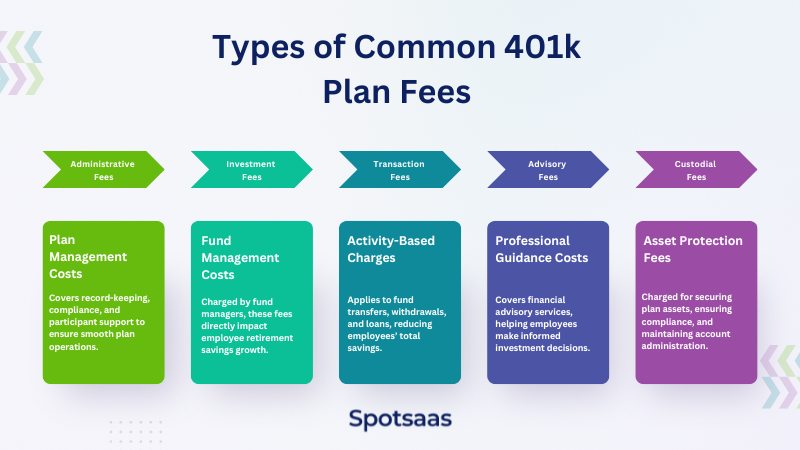
Administrative Fees: Common Types of 401(k) Fees Employers Should Understand
These fees cover the cost of managing the 401k plan, including record-keeping, compliance, and participant support. They can be charged as a flat fee per participant or as a percentage of total assets.
Businesses often pay these fees to maintain compliance with IRS regulations and ensure smooth plan operations. Regular plan maintenance, employee education, and annual filings are also included in administrative costs.
Investment Fees: Expense Ratios and Fund Management Costs
Investment fees are charged by fund managers to cover the costs of managing mutual funds, ETFs, Target Date Funds or other investments in the plan. They are typically expressed as expense ratios, which can range from 0.05% to over 1% of assets annually.
Choosing low-cost funds helps maximize employee retirement savings by reducing long-term costs. These fees directly impact an employee’s total returns, making it crucial to select providers with transparent and competitive pricing.
Transaction Fees: Charges on Loans, Withdrawals, and Transfers
These fees apply when participants make certain transactions, such as fund transfers, 401k loans, or early withdrawals. Some providers include transaction fees in overall plan pricing, while others charge them separately.
Employers should review these costs to avoid unexpected charges that could impact plan participation. Frequent transactions can accumulate fees over time, reducing the total retirement savings available to employees.
Advisory Fees: Cost of Investment Advice and Robo-Advisors
Many 401k plans offer professional investment advice, which can be provided by financial advisors or automated robo-advisors. These fees may be charged as a flat rate or as a percentage of assets under management.
Personalized advisory services typically cost more but can help employees make informed retirement decisions. Some providers include advisory services as part of their overall plan management, while others charge additional fees for one-on-one consultations.
Custodial Fees: Safeguarding Plan Assets and Regulatory Compliance
Custodial fees are charged by financial institutions responsible for holding and safeguarding 401k assets. These fees cover regulatory compliance, fund administration, and account security.
While often small, they are an essential part of maintaining a legally compliant and secure retirement plan. Proper custodial services ensure that funds remain protected and accessible for employees when they reach retirement.
How 401(k) Fees Reduce Retirement Savings Over Time
It is of utmost importance for both employers and employees alike to understand just how 401k fees affect retirement savings. Even minor variances in 401k fees can profoundly influence financial outcomes.
While a 1 percent variation in fees may seem small at the outset, the compounding interest over 30 or 40 years can cause your retiree balance to diminish remarkably. So consider the case where an employee is putting aside $500 a month with an average rate of return of 7 percent. A difference in 401k fees of just 1 percent could cause that employee to lose almost $100,000 over 35 years simply by paying that extra fee.
Therefore, an employer should check and compare the 401k fees before selecting a plan provider, including investment management costs, admin expenses, and participant service charges. Constantly watching the retirement fees, along with the provision of transparency, maximizes retirement savings for employees.
Real-Life Example: How Fees Can Drain Retirement Funds Over 30 Years
401k contributions grow over time through compound interest, where returns generate additional earnings. However, excessive fees reduce the amount of money invested, ultimately lowering the compounding effect. Consider two employees who each invest $10,000 annually into their 401k for 30 years:
- Employee A: Pays 0.5% in fees, earning an average 7% return annually.
- Employee B: Pays 1.5% in fees, with the same 7% return before fees.
After 30 years, Employee A’s account grows to approximately $920,000, while Employee B, who pays 1% more in fees, accumulates only $760,000—a $160,000 loss due to fees alone. This example highlights why even minor fee differences can have a profound effect on retirement outcomes.
Best Low-Cost 401(k) Providers with Transparent Pricing in 2025
401k providers with low-cost index funds, minimal administrative fees, and transparent pricing allow employees to keep more of their earnings invested. Vanguard, Fidelity, and Guideline are examples of providers known for low-expense ratios and flat-fee pricing models that maximize employee benefits.
By carefully evaluating fees, employers can select a provider that balances affordability with quality service. Reducing unnecessary costs helps employees build larger retirement savings, improving financial security for the future.
How to Reduce 401k Fees Plan Fees and Maximize Employee Savings
Minimizing 401k fees is essential for maximizing retirement savings. Even a small reduction in fees can significantly increase long-term returns. Employers can take several strategic steps to lower costs while maintaining a high-quality retirement plan for employees.
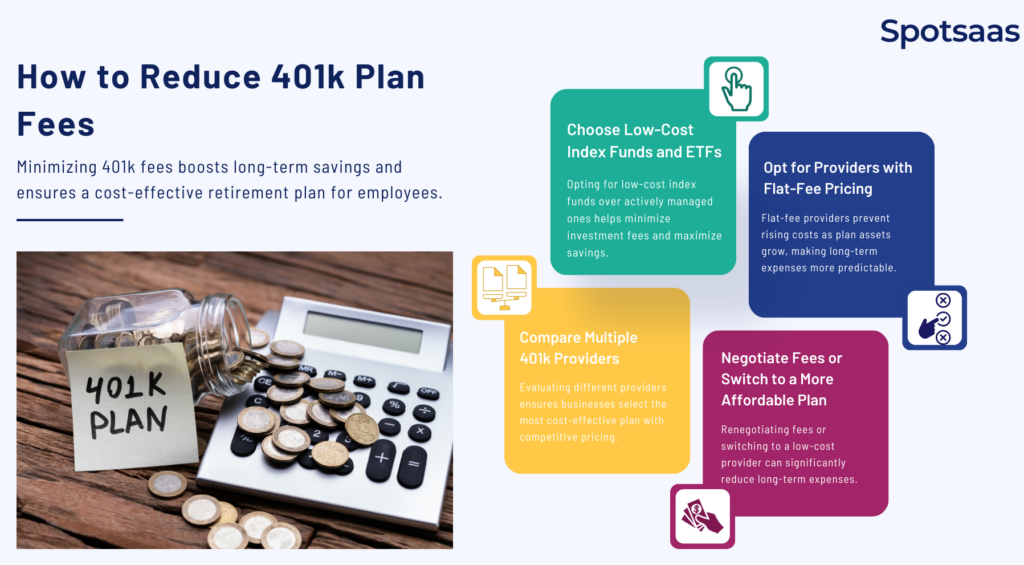
Step 1: Choose Low-Cost Index Funds and ETFs for Lower Investment Fees
Investment fees, often hidden within expense ratios, can eat away at returns over time. Opting for low-cost index funds and ETFs instead of actively managed funds helps reduce costs while still providing solid growth potential.
Providers like Vanguard and Fidelity offer index funds with expense ratios as low as 0.03%, significantly lower than the 1%+ fees of some actively managed funds. Lower expense ratios mean employees retain more of their contributions, increasing their overall retirement savings.
STep 2: Select 401(k) Providers with Flat-Fee Pricing Models
401k providers typically charge fees either as a flat rate per participant or as a percentage of assets under management (AUM). Flat-fee structures are often more cost-effective for businesses as they prevent fees from increasing as plan assets grow.
Providers like Ubiquity Retirement + Savings and Guideline offer transparent flat-fee pricing, making costs more predictable for employers. Switching to a flat-fee provider can significantly cut long-term costs for both employers and employees.
Step 3: Compare Top 401(k) Providers for Fee Transparency and Features
Every provider has a different fee structure, and businesses can save by shopping around. Employers should compare administrative fees, investment expenses, transaction costs, and advisory fees across different providers to find the most cost-effective plan.
Many providers, including Empower Retirement, Human Interest, and Paychex, offer competitive pricing with features tailored to different business sizes. A detailed comparison ensures businesses select a provider that offers the best value for their specific workforce needs.
Step 4: Negotiate or Switch to a More Affordable 401(k) Plan
Many businesses accept high fees without questioning them, but negotiating fees can lead to lower costs. Employers can request lower administrative fees, better investment options, or waived transaction costs when working with their provider.
If the current plan remains too expensive, switching to a low-cost provider can result in significant long-term savings for both the business and its employees. Regularly reassessing the plan’s cost-effectiveness helps businesses keep up with better pricing options in the market.
Low-Cost 401k Provider Comparison Table: Admin and Investment Fees
| Provider | Admin Fees | Investment Fees | Key Features |
|---|---|---|---|
| Fidelity Investments | $500 setup, $300/quarter admin | 0.125% per quarter | Wide investment options, strong support |
| Vanguard | Low-cost structure, fees vary | Avg. 0.10% expense ratios | Focus on low-cost index funds |
| Guideline | $49/month + $8/employee, no setup | No direct investment fees | Fully automated, payroll integration |
| Ubiquity Retirement + Savings | $97/month, $495 setup fee | No asset-based fees | Transparent flat-fee pricing, customizable plans |
Why These 401(k) Providers Offer the Best Value in 2025
- Lower Fees: Flat-rate or low-cost models reduce overall plan expenses.
- Transparent Pricing: No hidden charges, making costs predictable.
- Automated Services: Simplifies administration and compliance.
- Low-Cost Investment Options: Helps maximize employee retirement savings.
Choosing a low-cost 401k plan provider ensures better savings growth and reduced overhead for businesses.
Hidden 401k Fees That Could Be Draining Your Plan
While some 401k fees are clearly outlined, others may be buried within investment costs or administrative charges. These hidden fees accumulate over time, decreasing the total retirement savings.
Employers should carefully review plan disclosures to identify and minimize unnecessary expenses. Below are some of the most common hidden fees in 401k plans.
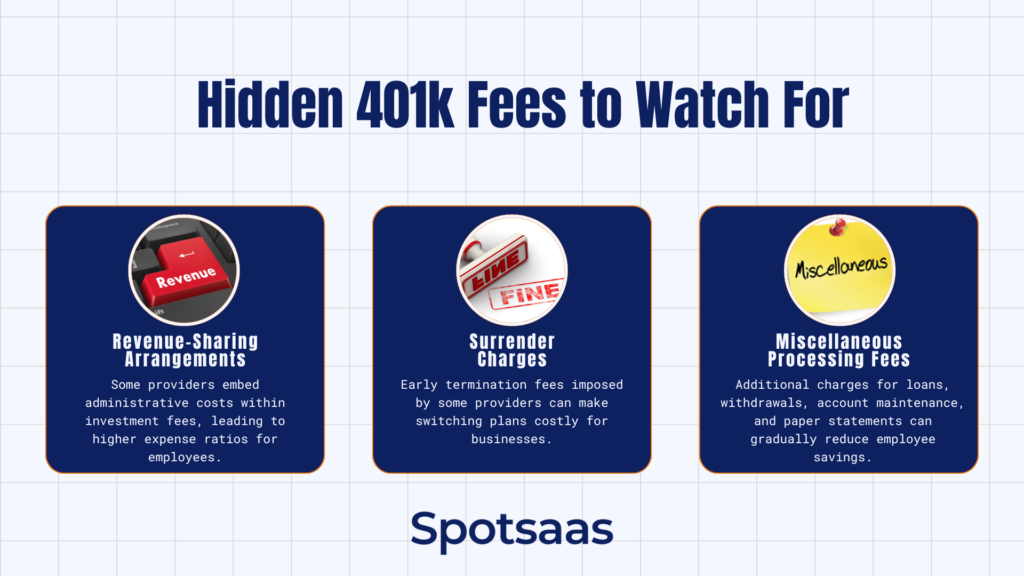
Revenue-Sharing in 401(k) Plans: What It Means and Why It Matters
Some 401k providers engage in revenue-sharing agreements, where investment fund providers pay a portion of their fees back to the plan administrator or record keeper. This cost is often deducted from the expense ratio of investment funds, meaning employees indirectly pay for plan administration through higher investment fees.
Although revenue-sharing helps offset employer costs, it can result in higher expense ratios for participants, leading to lower net returns. Employers should choose low-cost funds with transparent pricing to prevent employees from unknowingly paying inflated fees.
Surrender Charges: Exit Fees That Can Hurt Your Business
Some 401k providers impose surrender charges or exit fees when a business decides to switch to a new plan administrator. These fees act as a penalty for terminating the contract early and can range from a few hundred to several thousand dollars, depending on the provider.
Surrender charges are particularly common in plans that include bundled services, where administration, investment management, and record-keeping are handled by a single provider. Before selecting a provider, businesses should review the contract terms to ensure there are no excessive penalties for switching plans in the future.
Miscellaneous 401(k) Processing Fees to Look Out For
401k providers may charge additional fees for specific account activities, including:
- Loan processing fees – Applied when employees take out a loan against their 401k savings.
- Distribution fees – Charged when employees withdraw funds at retirement or roll over assets to another plan.
- Account maintenance fees – Ongoing charges for administrative support, even if an employee is no longer contributing.
- Paper statement fees – Some providers charge extra for paper account statements instead of online access.
These fees may seem small individually, but over time, they reduce the total savings employees accumulate. Employers should work with transparent providers that minimize extra charges and clearly disclose all costs upfront.
Tips to Avoid Hidden Fees in Your 401(k) Plan
To ensure cost-efficiency and transparency, businesses should:
- Review the fee disclosure statement (408(b)(2) document) to understand all costs.
- Ask providers about revenue-sharing models and look for low-cost fund alternatives.
- Check for surrender charges before committing to a long-term contract.
- Choose a provider with flat, transparent pricing to avoid excessive processing fees.
By identifying and eliminating hidden fees, businesses can reduce plan costs, maximize employee savings, and create a more efficient retirement plan for their workforce.
Final Thoughts: Choosing a Cost-Effective 401(k) Plan for Better Savings
Understanding 401k fees is essential for both businesses and employees, as even small cost differences can significantly impact long-term retirement savings. High administrative, investment, and transaction fees can reduce overall returns, making it crucial to select a provider with transparent pricing and cost-effective investment options.
Businesses should review plan fees annually to ensure they are offering a competitive and efficient retirement benefit. Regularly comparing providers, negotiating fees, and optimizing investment selections can help reduce unnecessary costs while maximizing employee savings.
Choosing the right 401k plan provider ensures financial security for employees and cost efficiency for employers. Compare 401k providers today to find a plan that aligns with your business goals and supports your workforce’s long-term financial well-being.
Frequently Asked Questions About 401(k) Fees and Cost Management
What are the most common fees in a 401k plan?
401k plans typically include administrative fees, investment fees, transaction fees, advisory fees, and custodial fees. These costs cover plan management, fund operations, and compliance.
How do high 401k fees impact retirement savings?
Even a 1% increase in fees can reduce an employee’s total savings by thousands of dollars over time due to compounding. Lower fees help maximize retirement growth.
How can businesses reduce 401k fees?
Employers can minimize costs by choosing low-cost index funds, opting for flat-fee providers, comparing multiple providers, and negotiating lower fees with their current plan administrator.
What’s the difference between flat-fee and asset-based 401k pricing?
Flat-fee pricing charges a fixed rate per participant, while asset-based pricing takes a percentage of total assets, which can become costly as plan balances grow.
How often should businesses review their 401k fees?
Companies should review their 401k fees annually to ensure they remain competitive, cost-effective, and aligned with employee needs. Adjustments may be needed as business and market conditions change.
