
The Rise of AI in Security: By the Numbers
A report from Markets and Markets predicts that the AI-in-security market will reach $38.2 billion by 2026, growing at a CAGR (compound annual growth rate) of 23.6%. That kind of growth rate signals a market that is scaling quickly, not one still in early experimentation. A separate survey published by Capgemini in July 2021 found that more than 69% of organizations had already begun implementing AI to help identify and prevent threats. Together, these numbers illustrate how central AI has become to this space.
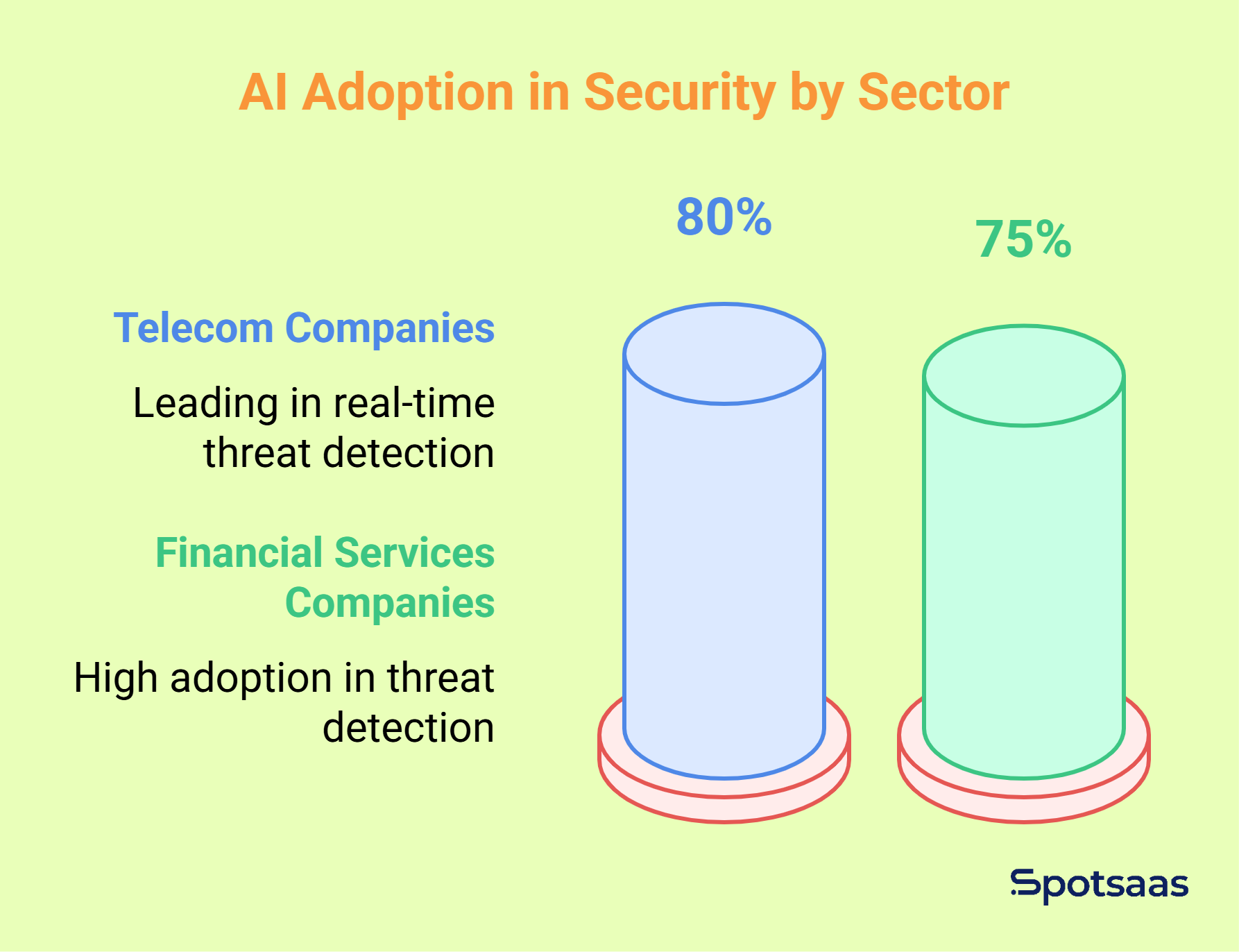
Among the organizations surveyed, 80% of telecom companies and 75% of financial services companies had already put AI to work in real-time threat detection. That tells us AI is an active part of existing security infrastructure today, not a future idea organizations are still weighing.
What This Article Covers
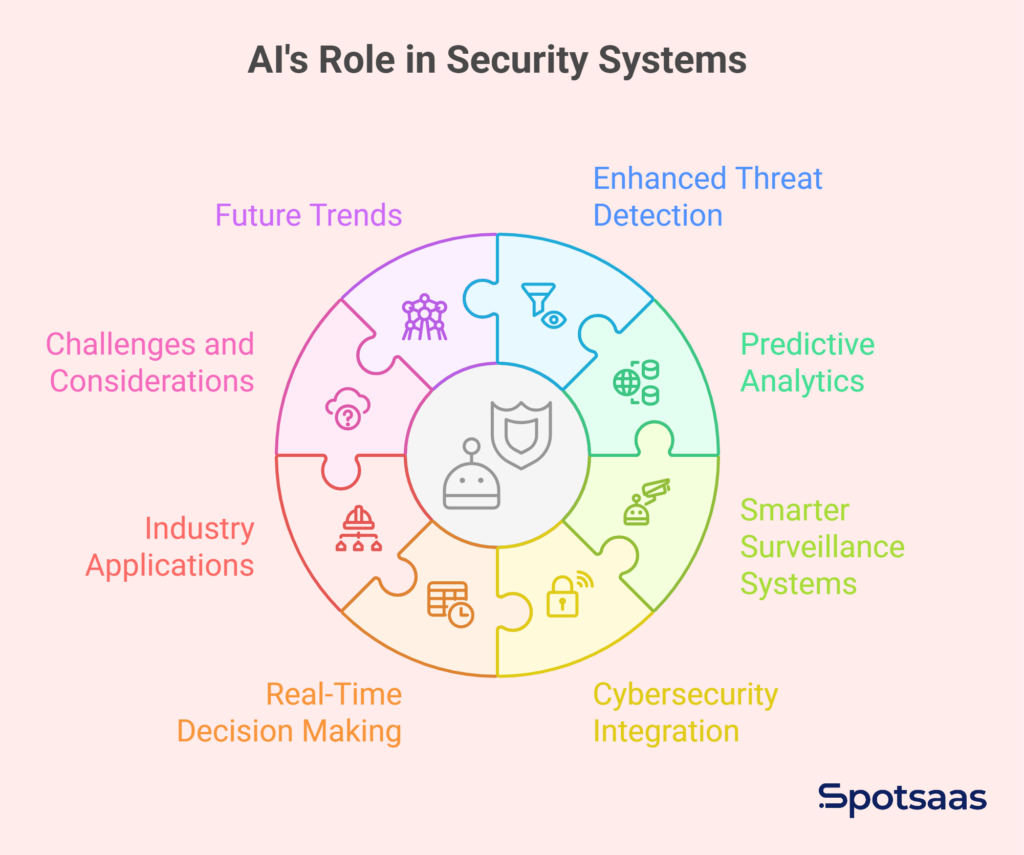
This article looks at how AI is changing today’s security systems across physical, cybersecurity, and operational threat domains. First, we cover how AI strengthens threat detection and predictive analytics. Then we look at the efficiencies AI brings to automating security operations, managing surveillance, and supporting faster decisions.
Finally, we cover how AI is used in practice across different industries, with real-world examples. Each section ends with a practical takeaway, and the article closes with FAQs, a key-takeaways summary, and a conclusion.
Enhanced Threat Detection
AI speeds up and sharpens how threats get detected. Older security tools tend to rely on rule-based checks or human review, and neither is built for a fast response — rule-based checks only catch what they were explicitly programmed to look for, and human review takes time that a live threat doesn’t always allow. An AI or machine learning security tool evaluates threats, breaches, or anomalies the moment they occur.
Compared with human analysts, AI systems can process huge volumes of data from sources like CCTV feeds, access records, and network traffic almost instantly. That lets organizations catch patterns that point to a breach or suspicious activity, which cuts down false positives while also supporting compliance.
Predictive Analytics for Proactive Security
Beyond detecting a threat after it happens, AI can strengthen an organization’s overall security posture through predictive analytics. AI models analyze past data to flag likely future vulnerabilities, alerting security teams before those vulnerabilities turn into incidents. That gives teams time to close a gap before it gets exploited, rather than responding after damage is already done.
For example, in the cybersecurity space, AI can predict malware infections by analyzing user and company behavioral patterns. In physical security, AI can forecast possible break-ins by looking at time patterns, past break-in events, and weather conditions. These predictive capabilities let organizations move from a reactive security posture to a preventive one.
Smarter Surveillance Systems
Surveillance is another area AI has changed. AI-powered cameras can monitor a property without the errors that come with human attention spans, recognizing unusual behavior, faces, and motion.
That turns modern surveillance systems into more than a video feed — they produce usable data. This is a big part of why businesses look for the best NVR security system rather than a plain camera setup. Companies like Coram AI are pushing this forward with intelligent NVR solutions that build in real-time facial recognition and object detection to improve situational awareness.
Cybersecurity and AI Integration
AI also plays a core role in cybersecurity. It can flag zero-day vulnerabilities, catch phishing attempts, and simulate cyberattacks to test how well a system holds up before a real attacker gets the chance to.
AI can continuously audit network traffic and act as a first line of defense, isolating threats without waiting for a person to step in. That combination allows for faster containment and resolution of breaches, which matters for limiting damage and lost productivity.
Real-Time Decision Making
AI also helps security personnel make faster, more accurate calls during an incident. It can pull together and analyze data from multiple sources at once, giving personnel a single view of what’s happening.
That single view supports a better response. In a physical breach, for example, AI can assist emergency response by suggesting evacuation routes based on real-time information.
Applications Across Industries
AI-enabled security systems now show up across a range of industries. In healthcare, they verify secure access to patient records while keeping facility safety in mind. In retail, they support loss prevention by analyzing customer behavior. In manufacturing, they secure operational technology networks and help guard against industrial espionage. Each of these industries has different assets to protect, but the underlying job — flag what’s abnormal, fast — stays the same.
Smart cities use AI to monitor public spaces, manage traffic, and respond to emergencies more effectively. The range of use cases shows how scalable and adaptable AI is across very different settings.
Challenges and Considerations
Using AI in security infrastructure comes with real challenges. Data privacy, system transparency, and regulatory compliance all matter here. AI-trained systems are also only as good as the data they were trained on, which makes data quality a serious consideration — biased or incomplete training data can lead to missed threats or false alarms just as easily as it can improve detection.
Another point worth weighing is the ethical side of surveillance itself — how these applications line up with accepted norms and legal obligations in society.
Future of AI in Security
Going forward, AI in security is likely to become more autonomous and more fully built into edge devices. Federated learning, explainable AI, and related technologies should help address privacy concerns while keeping performance high.
Expect AI to show up more in national security strategies and in protecting critical infrastructure. As threats keep evolving and growing more sophisticated, investment in AI-based security is likely to keep growing with them.
FAQs
What is the main advantage of using AI in security systems?
The primary benefit is real-time threat detection and reduced response time, which enhances overall security effectiveness.
Are AI security systems suitable for small businesses?
Yes, many AI-driven solutions are scalable and can be adapted for use in small and medium-sized enterprises.
Is AI in security expensive to implement?
Initial costs may be higher, but long-term savings from reduced labor and improved efficiency often offset the investment.
Key Takeaways
- AI detects threats broadly and accurately in real time across different platforms.
- Predictive analytics helps organizations act proactively rather than reactively on security.
- AI-enhanced surveillance systems turn footage into data teams can actually act on.
- Automation through AI applies consistency to security operations and helps reduce operating costs.
- Its use across industries shows how versatile and scalable AI-based security really is.
- Ethical and privacy concerns need thoughtful, ongoing attention as adoption grows.
- AI’s role in security is set to keep expanding as the technology matures.
Conclusion
Artificial intelligence is having a major influence on modern security architecture. It offers proven, scalable, and efficient ways to secure physical and digital assets, through predictive analytics, automated surveillance, real-time decision-making, and applications across industries. There are real challenges to address, but the benefits outweigh them.
