
In 2025, data science and AI reshaped nearly every industry. Companies increasingly rely on data to innovate and find a competitive edge, which has made data science and AI skills some of the most in-demand on the job market. That demand shows up across research labs, product teams, and operations groups — different departments, but all leaning on roughly the same core skill set to get there.
Most advanced online courses offer hands-on, structured learning from well-known institutions, covering deep learning, neural networks, generative AI, and related subjects. Completing one of these programs can open doors to an AI research, analytics, or automation job.
Flexible learning options and a credible certification give you an edge in a crowded job market. The strongest programs are built to keep your skills relevant as the field keeps changing.
Evolution Of Data Science and AI Education
Historically, data science courses taught statistical analysis, machine learning algorithms, and data visualization. Those subjects are still central, but the field has expanded into deeper subfields like deep learning, natural language processing, and generative artificial intelligence.
Advanced courses have adapted to these trends by training students to work with emerging technology on their own and build AI-powered solutions for real use cases. That shift matters because the tools themselves change faster than any single curriculum can keep pace with — so the more useful skill is learning how to pick up a new model or framework quickly, not just memorizing the ones taught in class.

Core Concepts Covered in Advanced Courses
The advanced data science and generative AI course covers several core concepts that go beyond the basics of data science. These include:
Advanced Statistical Modeling: This covers statistical techniques such as Bayesian inference, time series analysis, and survival analysis. Students learn to apply these methods to analyze complex datasets and make predictions.
Deep Learning Architectures: This covers convolutional neural networks (CNNs) for image recognition, recurrent neural networks (RNNs) for sequential data processing, and transformer models for natural language processing. Students learn how to build, train, and optimize each of these for specific tasks.
Natural Language Processing: This covers how machines interpret human language. Students learn text mining, sentiment analysis, machine translation, and chatbot development, and how to apply these techniques to build practical applications.
Generative AI Models: These models generate new content — images, text, audio, and code. Courses cover Generative Adversarial Networks (GANs), Variational Auto-Encoders (VAEs), and diffusion models, and how to apply them to creative work in the arts, entertainment, and design.
Reinforcement Learning: This technique trains an agent to find the best strategy through trial and error, using rewards and penalties. Students apply it to demanding control problems like robotics, game playing, and resource management.
Big Data Technologies: As data volumes keep growing, advanced courses still cover big data technologies like Hadoop, Spark, and cloud computing platforms. Students learn how to process large datasets in a distributed computing framework.
Cloud Computing and Deployment: Deploying and scaling data science and AI models in the cloud is now a baseline skill. Courses teach students how to use cloud platforms such as AWS, Azure, and Google Cloud to deploy the models they build.

Essential Skills You’ll Acquire
These advanced courses are built around the skills employers actually look for. Among them are:
High-Level Programming: Python is the baseline requirement, along with familiarity with libraries like TensorFlow, PyTorch, Scikit-learn, and Pandas. Students also learn to write clean, efficient, well-documented code for data analysis and AI model development.
Data Wrangling and Preprocessing: This covers cleaning, transforming, and preparing data for analysis and model training. Students learn to handle missing values, outliers, and inconsistent data, and how to engineer new features that improve model performance.
Model Evaluation and Tuning: Evaluating AI models and tuning them for performance is a core skill. Students work with metrics like accuracy, precision, recall, and F1 score, and learn how to tune hyperparameters using cross-validation.
Communication and Visualization: Data-driven insights are only useful if audiences without a technical background can understand them. Courses teach students to build clear visualizations in tools like Tableau and Power BI, and to present results in a way that’s easy to follow.
Problem Solving and Critical Thinking: Data science and AI work is ultimately about solving real-world problems. Case studies, projects, and simulations give students practice at asking the right questions, reviewing existing data, and landing on a workable solution.
Top Platforms for Advanced Training
A number of platforms in the online learning space offer advanced training in data science and AI. What separates the credible ones from the rest is usually the same handful of things: real partnerships with universities or employers, hands-on project work rather than video lectures alone, and a certification that other employers actually recognize. One example:
Great Learning
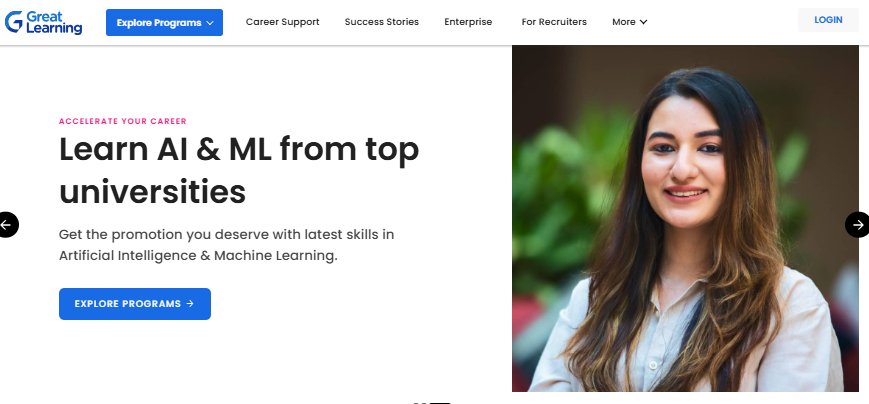
Great Learning is a professional education platform used by more than 10 million learners in 170+ countries. It offers industry-specific programs in AI, data science, and machine learning through partnerships with universities and institutions, backed by a network of 500+ hiring partners. Programs combine hands-on projects with certifications recognized internationally.
Career Paths for Data Science and AI Professionals
Advanced data science and AI training qualifies practitioners to pursue several in-demand professions. The roles below overlap more than the job titles suggest — most data teams need people who can move between a few of them depending on the project. They include:
Data Scientist: Data scientists collect, analyze, and interpret information to discover patterns and insights that could guide business decisions.
Machine Learning Engineer: Machine learning engineers build and deploy machine learning models to solve real-world problems, working closely with data scientists to turn research into practical applications.
AI Engineer: AI engineers design and build intelligent systems that can perform tasks requiring human intelligence, such as learning, problem-solving, and decision-making.
NLP Engineer: An NLP engineer builds applications to understand and process human languages, such as chatbots, machine translation systems, and sentiment analysis tools.
Generative AI Specialist: This role develops and deploys generative AI models that create new content, including images, text, music, and code.
Data Architect: Data architects design and maintain an organization’s data infrastructure so that data is stored, processed, and accessed efficiently and securely.
AI Consultant: AI consultants advise organizations on how to apply AI technology, and help them identify where it can move the business forward.
Navigating the Future of Data Science and AI Education
Data science and AI move fast enough that staying current takes deliberate effort. Continual learning is what separates people who keep up from people who fall behind, especially as new model architectures and tools show up every few months. A few ways to do it:
Follow Industry Blogs and Publications: Track developments through sources like KDnuggets, Towards Data Science, and the Journal of Artificial Intelligence Research.
Conferences and Workshops: Attend meetings and workshops to meet other professionals in the field and learn about current research and applications.
Contribute to Open-Source Projects: This is a solid way to gain hands-on experience and build a portfolio.
Pursue Advanced Certifications: Certifications in niche areas of data science and AI signal competence to employers and give you formal recognition for the skills you’ve built.
Conclusion
Demand for skilled data science and generative AI professionals is likely to keep growing in the years ahead. Investing in advanced online courses and updating your skills regularly puts you in a strong position for a fulfilling career in this field.
Data has been called the new oil for a reason — the people who know how to work with it are the ones building the next wave of AI tools. Choose the right courses, keep building your skills through continuous learning, and you’ll be ready to take your place in the world of data science and AI. None of that requires a perfect starting point either; most of the career paths above are open to people who started in adjacent fields like software engineering, statistics, or analytics and picked up the AI-specific skills through exactly these kinds of advanced courses.
