
Does managing a project feel like trying to eat an elephant whole? Here’s something you might not know: breaking your work down into smaller, more manageable tasks using vertical slicing can make it easier than ever.
This blog post explains what vertical slicing is and how it’s used in project management, so you can navigate projects with less stress and more efficiency.
Key Takeaways
- Vertical slicing is a project management approach that involves breaking down a feature into smaller, functional pieces to be developed and delivered incrementally.
- It differs from horizontal slicing, which focuses on completing tasks or parts of a job rather than delivering a full feature.
- Vertical slicing matters in project management because it lets teams show steady progress, deliver value early and often, and gather feedback to make adjustments as they go.
Understanding Vertical Slicing
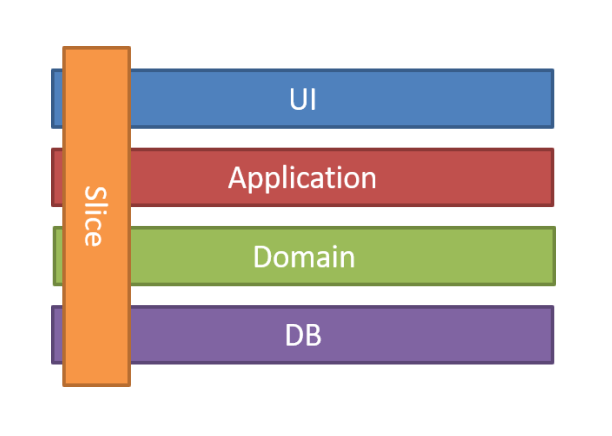
Vertical slicing is a project management approach that involves breaking down a feature into smaller, functional pieces to be developed and delivered incrementally.
Definition and purpose
Vertical slicing is a core part of how agile teams break up work. Picture cutting a cake into thin, tall pieces: each piece has every layer of the full cake, just like how each slice of a project carries every part of the job inside it.
A team takes one slice and finishes it end-to-end in a single cycle. The aim is to produce something working and useful by the end of each cycle. That way the team can show steady progress and get quick feedback from the people who will actually use what they’re building.
It’s used often by teams following agile methods, since it speeds up getting things done and shows value fast rather than making stakeholders wait for a finished system.
How it differs from other approaches (horizontal slicing)
Vertical slicing is not the same as horizontal slicing. They’re two different ways to break down work in a project. With vertical slicing, the team delivers a full feature from top to bottom in one go.
The whole team works on it together, so it involves cross-functional collaboration. Think of it as one thin slice cut straight through the cake.
Horizontal slicing is more about tasks or parts of a job. Each layer gets built bit by bit, usually with a technical focus. That’s closer to peeling off just the icing, or just the middle layer, of that same cake.
Each type has its own purpose. Vertical slicing gets you an end-to-end feature faster and makes progress clear to the team and to outside stakeholders. But it can need more planning up front to pull off well.
Importance in project management
Vertical slicing matters in project management because it breaks work into small, focused parts. Each slice gives a full view of the project from start to end, which helps teams show steady progress instead of a long stretch of invisible work.
It delivers value early and often, which benefits everyone involved in the project. Feedback and change can happen faster with this method, and the idea behind a feature gets proven sooner because working products go out at every step.
The Vertical Slice in Action
To put vertical slicing into practice, a feature gets broken down into smaller, functional slices that can be developed and delivered independently. This lets stakeholders give feedback faster and makes sure value gets delivered at every iteration, not just at the end.
Breaking down a feature for vertical slicing
To implement vertical slicing in project management, breaking a feature down into smaller, manageable pieces matters most. Here’s how it typically gets done:
- Identify the feature to be sliced.
- Determine the functionality or user value of the feature.
- Split the feature into smaller user stories or tasks.
- Consider dependencies and prioritize the order of implementation.
- Define clear acceptance criteria for each slice.
- Assign each slice to a team member for development and testing.
- Deliver each slice incrementally, keeping end-to-end functionality intact.
- Gather feedback from stakeholders and make adjustments as needed.
Benefits of using this approach
Vertical slicing offers several benefits in project management. One is faster value delivery: by breaking work into small, narrow-focused pieces, teams can deliver features or functionality end-to-end in a single iteration.
That means stakeholders and users can start benefiting from the project sooner, instead of waiting for the entire system or product to be finished before seeing any results.
Another benefit is more transparency and feedback. With each iterative release, teams can show incremental progress and collect useful feedback from stakeholders and users, which surfaces issues or needed changes early, before they get expensive to fix.
Vertical slicing also gives a fuller view of the project’s development. Because each slice includes a bit of every layer or component involved, it’s easier to understand how everything fits together — and to show stakeholders the actual value and potential of the project as it takes shape.
Real-life examples of vertical slicing in software development
In software development, vertical slicing is commonly used to deliver features or functionality in small, focused increments. Say a team is building an online shopping website.
Rather than building the entire website at once, they can use vertical slicing to focus on specific parts first — for example, developing a feature that lets users browse products and add them to a cart.
That single slice would involve the front-end design, back-end functionality, and database integration all working together in one iteration. Once it’s complete, it can be tested and released as a standalone function before the team moves on to other features.
This approach means quicker feedback from stakeholders, and it’s easier to make changes based on user needs or market demands because you’re not waiting on a full release.
Video game development offers another real-world example. Game developers often build small sections or levels of a game called “vertical slices” that show off key gameplay mechanics, graphics, sound effects, and the overall feel of the game before the rest of it exists. Studios use that slice to pitch the game internally, secure budget, or show a publisher what the finished product will feel like, long before every level is built out.
Implementing Vertical Slicing in Project Management

To put vertical slicing into practice, prioritize user stories and check that the INVEST principles are met for iterative development and delivery. It also helps to explore tools built for splitting work this way.
Prioritizing user stories
Prioritizing user stories matters a lot when putting vertical slicing into practice. A few points worth keeping in mind:
- User stories should be prioritized based on their value to end users or stakeholders, so the most important features get delivered first.
- Prioritization can weigh factors such as business impact, customer feedback, market trends, and project goals.
- The team should work with stakeholders to gather their input and agree on priorities together.
- A backlog of user stories can be created, with each story assigned a priority level.
- Regular reviews of the backlog keep it current and reflect any changes in priorities or requirements.
Ensuring INVEST principles are met
Successful vertical slicing depends on meeting the INVEST principles. These guide the process and make sure the sliced features or functionality stay valuable and deliverable. Here’s what each one covers:
| INVEST Principle | Description |
|---|---|
| Independent | Each vertical slice should be independent, meaning it can stand alone as a complete and usable feature. |
| Negotiable | The scope of each vertical slice should be flexible and open to negotiation with stakeholders, allowing for adjustments based on feedback and priorities. |
| Valuable | Each vertical slice should provide value to the end-user or stakeholder, contributing to the overall goals and objectives of the project. |
| Estimable | The effort required for each vertical slice should be estimable, allowing for accurate planning and resource allocation. |
| Small | Vertical slices should be kept small in size, focusing on delivering specific functionality or features rather than trying to tackle too much at once. |
| Testable | The outcomes of each vertical slice should be testable, allowing for verification against acceptance criteria and ensuring quality standards are met. |
Iterative development and delivery
Iterative development and delivery sit at the center of vertical slicing in project management. It means continuously building, testing, and refining features or functionality across the whole project timeline.
With this approach, teams deliver value incrementally in each iteration instead of waiting until the end to show progress. That raises transparency and surfaces feedback early, which allows faster iteration and improvement.
Delivering small portions of work at a time lets stakeholders see tangible results and weigh in on further development. It also means changes or fixes can be made quickly, which leads to more efficient project execution overall, rather than discovering a mismatch between what was built and what was needed only after months of work.
Using tools for efficient vertical slicing
Teams can lean on a few tools to slice work efficiently. One is user story splitting, which helps break features down into smaller, manageable tasks.
Another is the INVEST principle itself, which helps prioritize user stories based on their value and feasibility. On top of that, iterative development and delivery keep feedback and course correction happening frequently rather than all at once at the end.
Using these together, teams can cut wasted effort and deliver value faster through vertical slicing.
Comparing Vertical and Horizontal Slicing
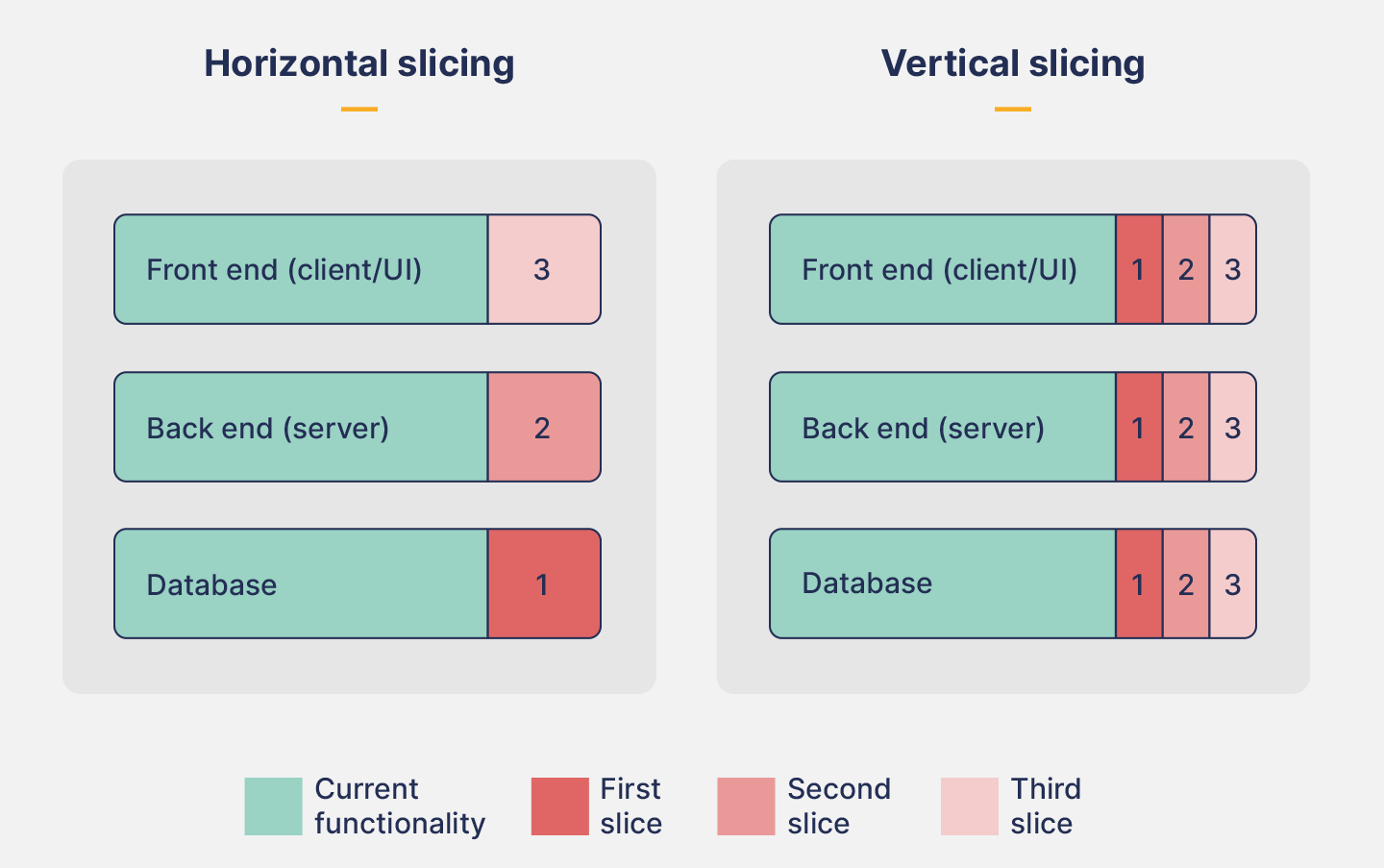
Vertical and horizontal slicing are two approaches used in project management, each with its own set of trade-offs. Neither one is universally “better” — the right pick depends on what the team is trying to prove at each stage of a project, and how much technical groundwork has to be laid before a feature can work end-to-end.
Pros and cons of each approach
Here’s how the advantages and disadvantages of each stack up:
| Approach | Pros | Cons |
|---|---|---|
| Vertical Slicing |
|
|
| Horizontal Slicing |
|
|
Which approach fits best depends on the project’s complexity, team structure, and objectives.
Choosing the right approach for your team
When deciding between vertical slicing and horizontal slicing, weigh your team’s specific needs and goals. Vertical slicing works well if you want to prioritize delivering value early and often, since it supports faster feedback and iteration.
It also lets you show stakeholders the project’s potential by demonstrating incremental progress across every layer of development. Horizontal slicing, on the other hand, may fit better if your team needs to focus on technical components and tasks within a single layer.
In the end, the right choice comes down to what works best for your team on efficiency, transparency, and value delivered.
Conclusion: The Power of Vertical Slicing in Project Management.
Vertical slicing is a useful approach in project management that lets teams deliver features or functionality end-to-end in a single iteration. By breaking work into small, focused pieces, it helps show progress and raises transparency along the way.
This method supports value delivery early and often, making faster feedback and iteration possible for better project outcomes.
Frequently Asked Questions
What is vertical slicing in project management?
Vertical slicing in project management refers to the technique of dividing a project into smaller vertical sections or increments instead of completing it horizontally.
How is vertical slicing used in project management?
Vertical slicing is used in project management to prioritize and deliver value early by focusing on key functionality within each increment, allowing for faster feedback and adaptation throughout the project.
What are the advantages of using vertical slicing in project management?
Using vertical slicing allows for quicker delivery of working features, enables continuous improvement through frequent feedback, reduces risks associated with large-scale implementation, and ensures better alignment with changing requirements.
Are there any limitations to using vertical slicing in project management?
While useful, implementing vertical slicing requires careful planning and coordination between teams, as well as clear communication about priorities and dependencies across different increments.
Can vertical slicing be applied to any type of project?
Yes, vertical slicing can be applied to various types of projects regardless of industry or sector as long as they can be divided into smaller functional segments that provide incremental value.
