
A data marketplace, or data market, connects the people who have data with the people who need it. It simplifies data procurement and gives organizations two things at once: a way to monetize data assets and a way to acquire insights they couldn’t easily produce on their own.
What is a Data Marketplace?
A data marketplace is an online platform for buying and selling data — think business intelligence, demographic information, market research, and other categories of external data that an organization can layer on top of what it already collects. Rather than sourcing every dataset independently, buyers can shop for it in one place, which improves data quality and encourages collaboration across industries that wouldn’t otherwise exchange information directly.
The simplest way to picture it: an online store, except the product is data. Providers list what they have, and buyers browse and purchase the datasets that fit their needs.
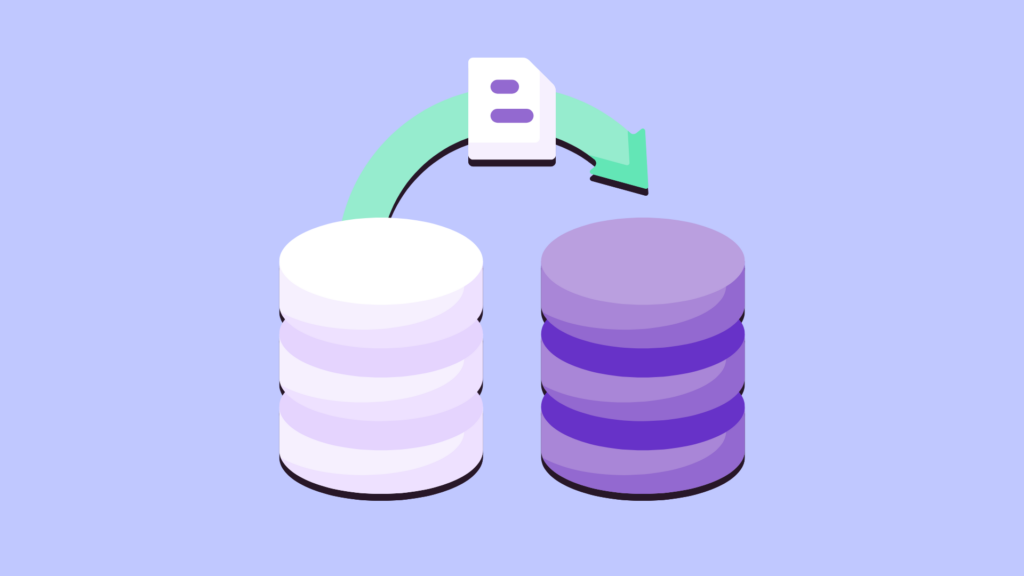
Data Marketplace Enhances Marketing Strategies
Marketing is one of the clearest places a data marketplace pays off. Instead of guessing at an audience, teams can pull in diverse, high-quality datasets that make targeting and personalization far more precise. A retail company, for instance, could buy detailed demographic and behavioral data on potential customers straight from a marketplace.
With that enriched data, the company can segment its audience more precisely and deliver marketing messages to specific groups instead of a generic broadcast. That kind of customization makes messages more relevant, which in turn raises the odds of engagement and conversion.
Marketplaces also tend to offer real-time data and market trend information, which lets marketers track shifts in consumer behavior as they happen instead of reacting to them months later.
Key Requirements for a Data Marketplace
A data marketplace worth using tends to share a few traits: a catalog that’s easy to search, strong security and privacy controls, consistently high data quality, and the infrastructure to handle large volumes of data and concurrent transactions. On top of that, it needs a user-friendly interface and the ability to integrate with other systems, so users can find, manage, and protect data without extra friction.

Data Catalog and Search Features
A data marketplace needs a catalog that’s simple to browse, where users can find and explore datasets without digging. Each entry should carry detailed metadata — descriptions, data formats, sources, and usage terms — so buyers know what they’re getting before they pay for it.
Filters and keyword search should be built in to help people find relevant data quickly, and the catalog should support categorization and tagging so datasets don’t get lost in a long, undifferentiated list.
Data Transactions and Privacy Controls
Security is non-negotiable in a data marketplace. The platform has to protect data with strong encryption during transactions, and privacy controls need to ensure only authorized users can access or purchase it. It should also comply with data protection regulations like GDPR or CCPA, since a lot of what’s traded touches personal or sensitive information.
Data Quality and Integrity Assurance
Keeping data quality and integrity high is one of the harder requirements to meet. A marketplace needs mechanisms for verifying and validating data before it’s ever listed for sale — data profiling, consistency checks, and quality assessments among them. Letting users rate and review datasets adds another layer of accountability, since it surfaces feedback on accuracy and reliability that the platform alone can’t catch.
Infrastructure and Performance
A data marketplace needs infrastructure built to scale, since it has to handle large volumes of data and concurrent transactions without buckling. That means a foundation strong and flexible enough to support fast, efficient data processing, so the platform stays responsive as the number of datasets and users grows.
Interface and Integration
The marketplace itself needs to be easy to navigate, with a clean design that makes finding and managing data straightforward rather than a chore. It should also integrate with the systems and applications you already use, whether through APIs or data export options. Support for APIs, common export formats, and compatibility with popular analysis tools makes the whole thing more usable and flexible in practice.
Top Data Marketplaces
Most established data marketplaces share the basics — easy sharing, real-time updates, access to a wide range of datasets — but they differ in scale and specialty. Here’s a look at some of the leading ones:
Snowflake Marketplace
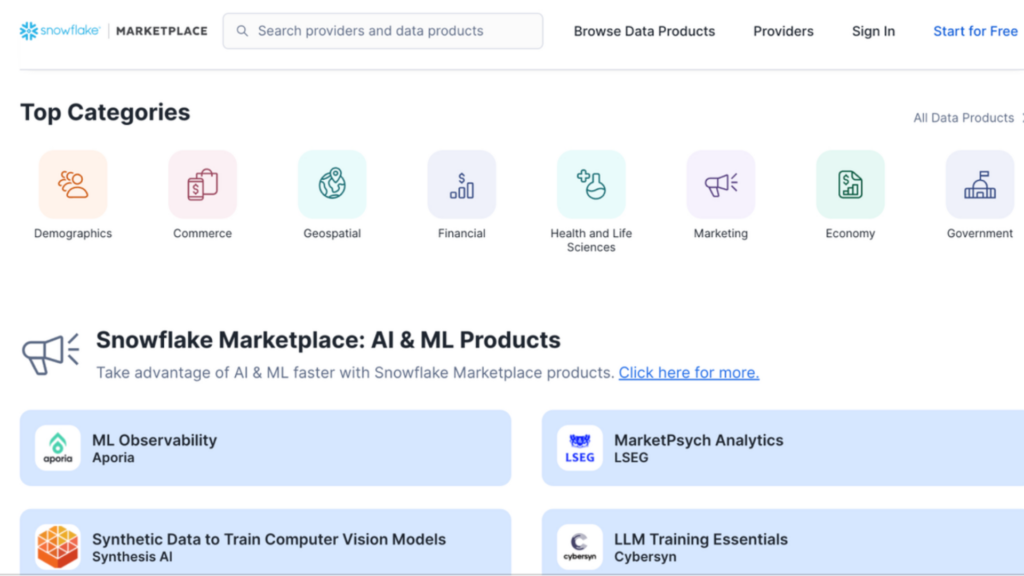
Snowflake Marketplace, part of the AI Data Cloud, is a global platform that simplifies sharing, collaborating on, and monetizing datasets, services, and entire data applications.
It connects users with over 580 providers, offering more than 2,500 data assets, applications, and AI products. Because it runs on the AI Data Cloud, it sidesteps traditional integration methods like ETL (Extract, Transform, Load), APIs, and FTP entirely.
Built on Cross-Cloud Snowgrid and Secure Data Sharing technology, Snowflake Marketplace keeps data accessible and updated in real time. That removes the need to copy data or manage complex integrations — users work with live content directly inside Snowflake instead.
Oracle Data Marketplace
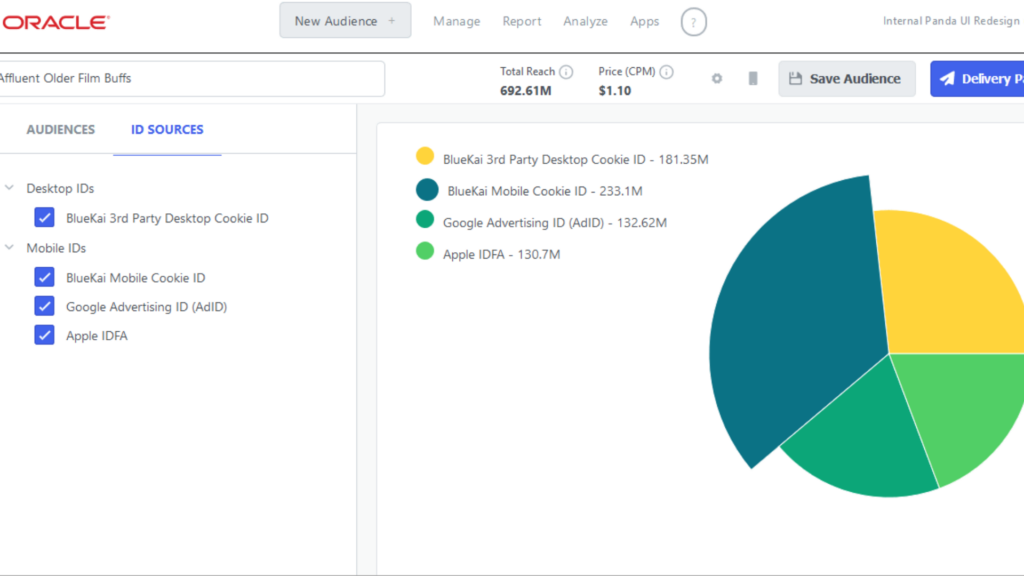
Oracle Data Marketplace is a broad platform built for open, transparent third-party data trading on a global scale. It provides over 30,000 data attributes covering many aspects of business and consumer behaviors, aimed at powering targeted marketing initiatives.
It runs on the Data Activation System™, a widely recognized standard for data management and analytics. That system supports effective data activation and management, ensuring the data can actually be put to work for ad targeting and other applications rather than just sitting unused.
Informatica Marketplace
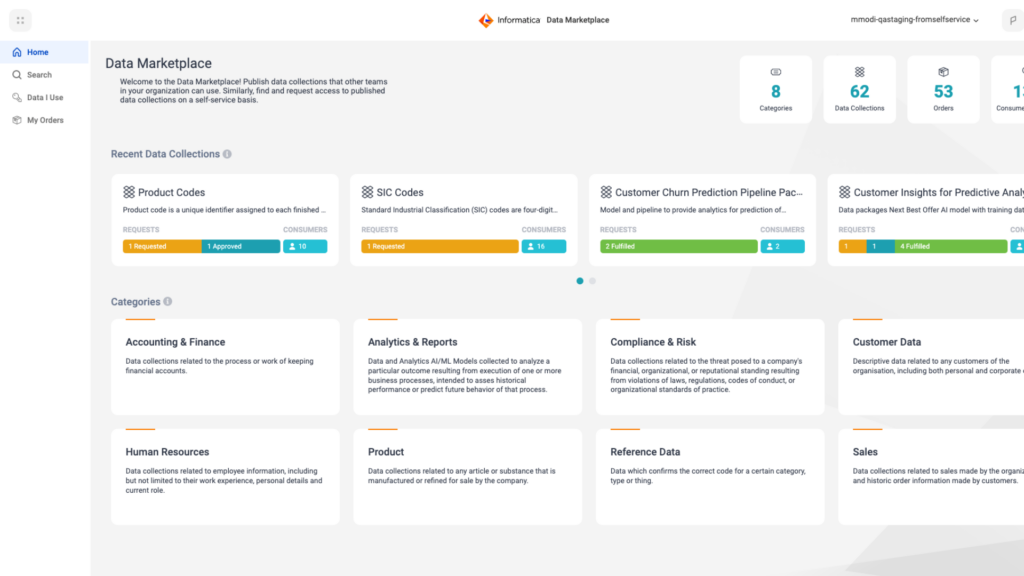
Informatica runs a secure data marketplace built around a confident data-shopping experience. The platform’s focus is on the responsible sharing of trusted data products that feed analytics and AI initiatives.
It automates data provisioning and delivery, which simplifies request management on both sides. As part of the AI-powered Informatica Intelligent Data Management Cloud (IDMC), it integrates with a wide range of complementary services — cloud data governance and cataloging, data quality and observability, and data lineage among them — that round out its overall data management capabilities and support stronger governance and quality practices.
Databricks Marketplace
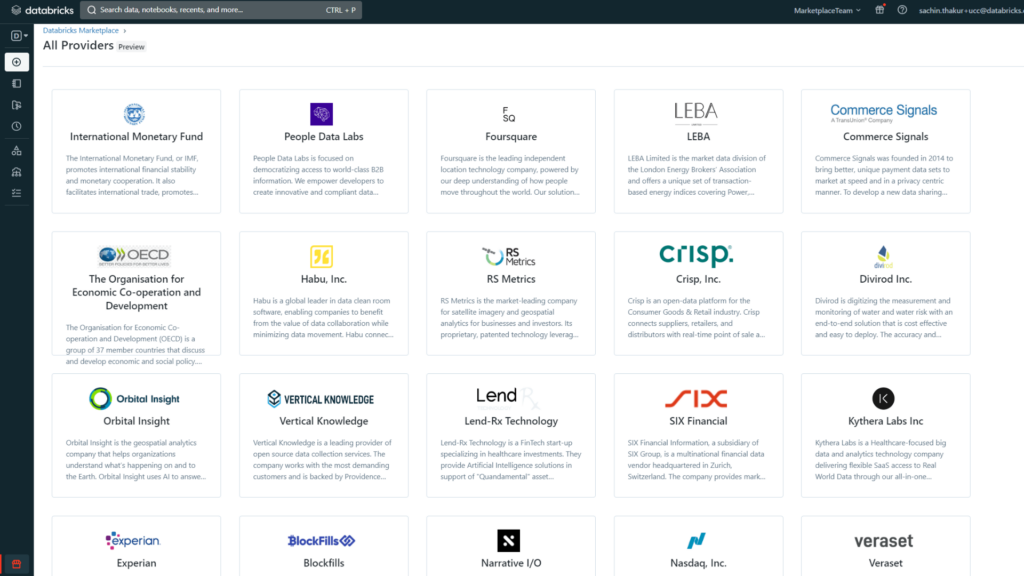
Databricks Marketplace runs on the open-source Delta Sharing standard, which makes data sharing and collaboration considerably more flexible. It cuts out the need for complex ETL processes and expensive data replication, and it throws in prebuilt notebooks and sample data so users can assess a data product quickly rather than committing blind.
AWS Data Exchange
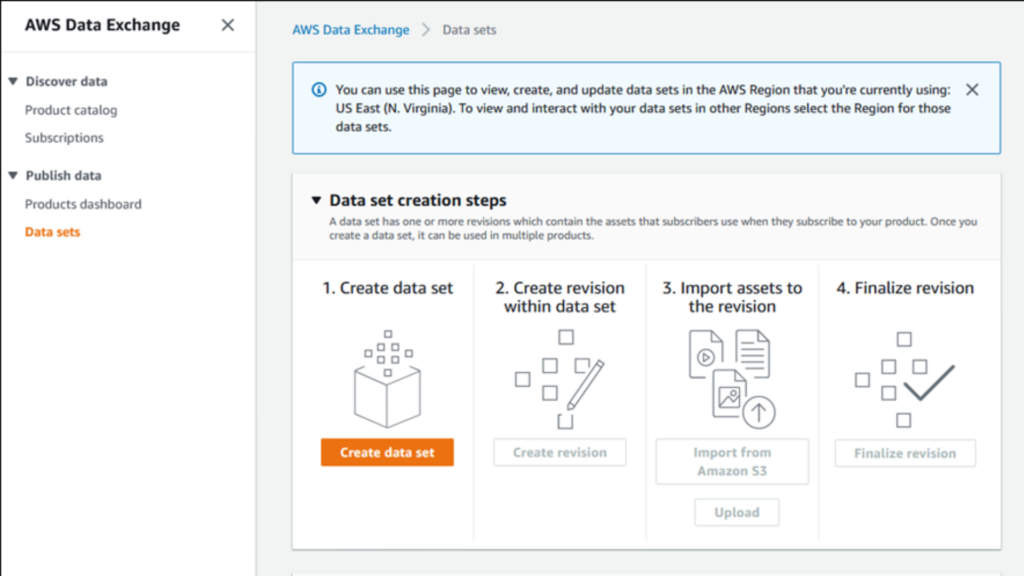
AWS Data Exchange lets users find, subscribe to, and use third-party data inside the AWS Cloud. Organizations can track and manage their data grants from one central location, and data receivers can run AWS or partner analytics and machine learning tools directly on the data they’ve acquired.
Publicly available datasets are also browsable through the Open Data on AWS program without needing an AWS account at all. On the seller side, providers who want to list data products in AWS Marketplace go through a review process to make sure they comply with AWS policies.
How to Build a Data Marketplace
The right approach depends entirely on what you’re trying to build.
If you want to build an internal data-sharing marketplace,
Start by listing everything you have: what data exists, where it’s located, and how it’s currently being used. A clear inventory like this makes every decision after it easier. Don’t skip data security — classify each dataset by sensitivity, set up strong access controls, and make sure only authorized people can view or share specific data. Put policies in place to keep data quality and compliance intact as the system grows.
If you’re leaning toward an external data marketplace platform instead, weigh how well it integrates with what you already run, along with its usability and scalability. The leading options worth comparing are Snowflake Marketplace, Oracle Data Marketplace, Informatica Marketplace, Databricks Marketplace, and AWS Data Exchange.
If you want to build a commercial data exchange marketplace,
Before you build anything, make sure the marketplace complies with data protection laws and regulations from the start. Draft clear terms of use and privacy policies to protect both buyers and sellers, and standardize data quality and formats so the two sides can actually interact without friction or inconsistency.
Security matters just as much on the transaction side. Implement strong data encryption and secure transfer protocols to keep data safe from unauthorized access.
Work out your pricing and monetization approach: a subscription fee, a pay-per-use model, or licensing the data outright. Build marketing and sales plans around that decision, and once the marketplace is live, keep analyzing performance and transaction data regularly — those insights are what let you adapt your strategy and improve the offering as market trends shift.
Conclusion
Data marketplaces have become a central part of modern data management. The ones worth using prioritize ease of use, strong security, high data quality, and solid infrastructure. And if you’re building one yourself, a clear data inventory, real security and compliance, and standardized quality are what actually determine whether it succeeds.
(Image Credit: spotSaaS/Snowflake/Oracle/Informatica/Databricks/AWS)
Frequently Asked Questions
What is a data marketplace?
A data marketplace is an online platform where people buy and sell data. It connects data providers with consumers, making it easier to acquire external data that enhances internal datasets and supports data monetization.
What are examples of data marketplaces?
Leading data marketplace examples include Snowflake Marketplace, Oracle Data Marketplace, Informatica Marketplace, Databricks Marketplace, and AWS Data Exchange.
What are the key features of a successful data marketplace?
A successful data marketplace has an easy-to-use catalog, strong security and privacy controls, high data quality, scalability for handling large volumes of data, and a user-friendly interface. It should also support integration with other systems.
How do I see the listing date on a data marketplace?
Look for a page like a dataset’s details page, which is usually the easiest place to find listing dates. Some marketplaces also offer filters based on listing date. If you cannot find it there, reach out to the seller directly.
