
🔗 Why This Blog Matters
401(k) loans offer a fast way for employees to access emergency funds without credit checks, but they come with potential risks that can harm long-term savings and trigger tax penalties. This blog breaks down the critical rules, timelines, and financial implications to help borrowers make informed decisions.
⚙️ What You’ll Learn Here
Understand the eligibility rules, repayment terms, and spousal consent requirements for 401(k) loans. Learn how taking a loan impacts investment growth, employer contributions, and retirement readiness. The guide also compares alternative financing options and outlines the exact steps to apply and repay a 401(k) loan successfully.
🏢 Who Should Read This
Perfect for employees considering borrowing from their retirement accounts, as well as employers who offer 401(k) plans with loan provisions. If you’re looking to understand the real costs, risks, and benefits of 401(k) loans before making a decision, this guide is your essential resource.
A 401k loan is a way for employees to borrow from their retirement savings without going through traditional lenders. Unlike personal loans or banks sending money, a 401k loan does not require any type of credit check and has the advantage that the interest paid goes back into the employee’s account.
Many employees borrow from their 401k for myriad reasons: emergency expenditures, settling some high-interest debts, or buying a home. Since it is their own money, there is likely more ease and speed in receiving one compared to applying for loans through other means.
Borrowing against retirement savings allows quick access to cash, yet it exposes the borrower to certain risks. In the event the borrower fails to repay on time, there are tax penalties and other potential consequences for early withdrawal. All rules, risks, and impacts on retirement savings should be understood before considering taking a 401k loan.
What Is a 401(k) Loan and How Does It Work?
Employers can use their 401k loan to pay off their retirement funds and repay it gradually with interest. The utilization of employer-sponsored plans allows for funds without the need to apply for a conventional loan from bank or lender.
The benefit of a Roth Federal 401k loan is that it doesn’t require borrowers to submit their credit check, making it an alternative for those who don’ not qualify for traditional loans. The employee’s vested balance is the source of the borrowed amount, which means they are borrowing from their savings instead of a bank.
In most cases, 401k loan principal and interest payments are automatically deducted from payroll for repayment. Borrowing money from a 401k account can still have an impact on long-term retirement savings due to missed market growth opportunities.
401(k) Loan Rules: Eligibility, Repayment, and Payroll Deductions
In order to avoid fines and hefty payouts, it is essential to familiarize yourself with the 401k loan rules and regulations.
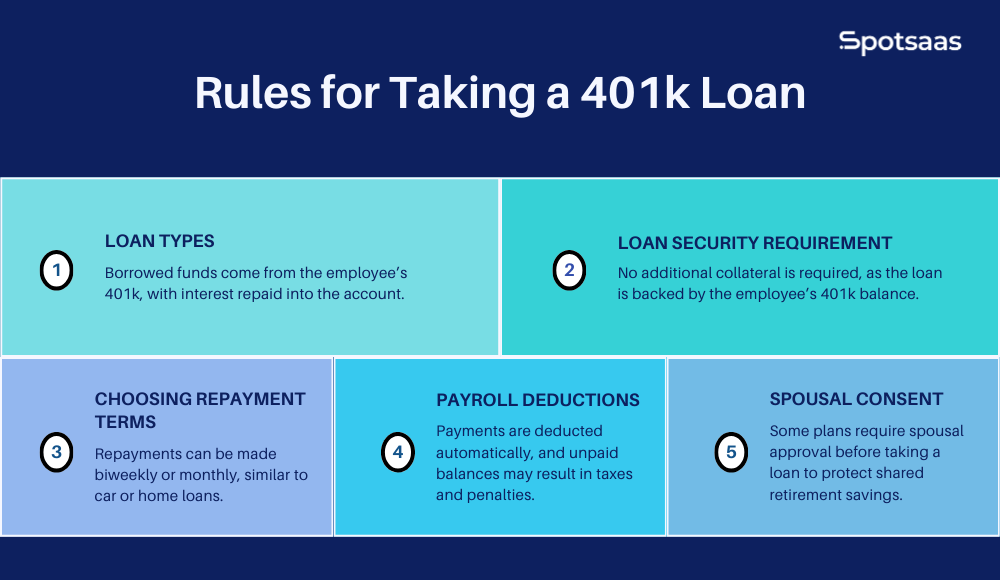
Below are some essential guidelines that employees must comply with:
Types of 401(k) Loans and What They Mean
These loans also fall into more than one category. Employees could apply for either a traditional “401k Loan” or the less common “Loan against a 401k.” Essentially, a classic “401k loan” is robbing oneself, and all interest generated on the loan is returned to one’s 401k account.
As such, each loan is considered an unsecured loan since you don’t have to pledge collateral apart from your 401k account. Conversely, a “loan against a 401k” may involve the borrower using their 401k as collateral. By doing this with such loans, the borrower may benefit from cash outlays while avoiding penalties.
Are 401(k) Loans Secured or Unsecured?
Employees are not required to collateralize the loan because the loan is secured by the amount of money they have already invested in their 401k. For example, a loan against a 401k allows the employee to use an asset that has already been accrued.
Prior to officially borrowing from your account, it is wise to consult with your company to check what form of guarantees on the loan are utilized.
How to Choose Repayment Terms for Your 401(k) Loan
An employee can either repay biweekly payments over one year or take a draw for a number of months. Such terms are no different from a standard car or home loan agreement, though it would help if one took a minute to assess it.
Besides getting paid and incurring interest on the above-mentioned loans, all other direct or third-party loans mentioned are not exempt from approval by clients if such loans are borrowed against accrued memberships.
How Payroll Deductions Work for 401(k) Loan Repayment
Loan repayments are automatically deducted from an employee’s paycheck, ensuring there are timely payments. An employee may have to liquidate the remaining balance to settle the loan within 60 to 90 days in order to avoid a tax well above the bar.
If the debt is not updated, an employee below 59½ years of age may find that this will be treated as taxable income, plus incur an early-withdrawal penalty. Knowing the terms of the plan ahead of time could prevent applicants from a nasty financial surprise.
Do You Need Spousal Consent for a 401(k) Loan?
In certain 401k plans, prior spousal consent is needed before an employee can take out a loan, particularly where retirement assets are considered joint property. This requirement then protects shared retirement savings.
Understanding the spousal consent rules keeps the process of loan approval smooth. Employees should discuss loan decisions with their spouses to ensure their goals in financial planning are aligned.
Check More – 10 Best 401K Service provider in 2025
Key Risks of Borrowing from Your 401(k) in 2025
How 401(k) Loans Impact Investment Growth
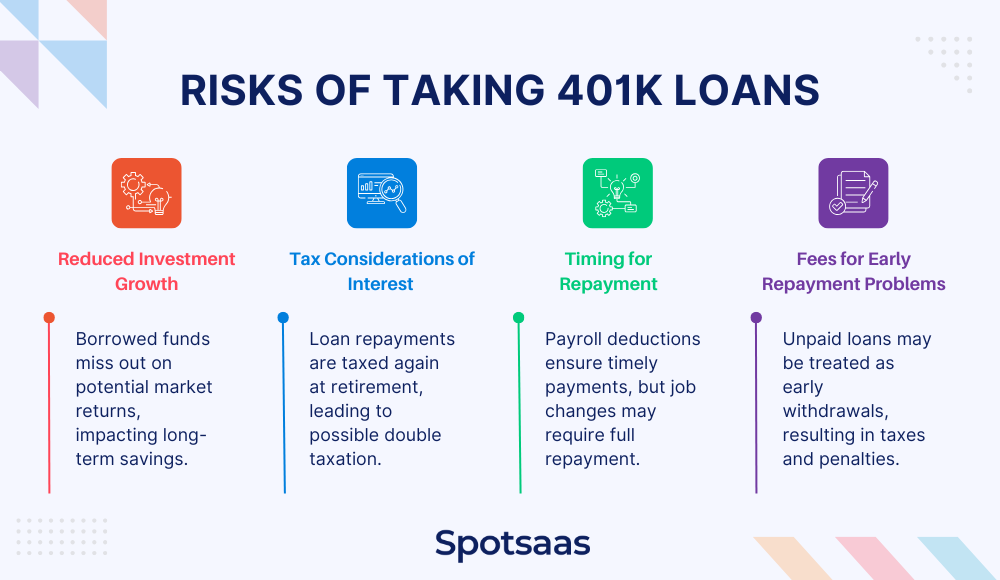
Taking a 401k loan means money is out of growth-based investments temporarily. During the time of the loan, this money does not gain from any potential market returns.
While the principal balance may be replaced by repaid loans, the unrealized gains from such loans may affect the long-term saving. In determining whether or not to make a loan, however, it is critical to understand how such a loan would affect one’s long-term retirement savings.
Are 401(k) Loan Interests Taxed? What You Need to Know
401k loans are taken on an interest owing at the end of a period of time. That means that money withdrawn in retirement will again be taxable as ordinary income in retirement once repaid.
Understanding the taxation of borrowing would be a helpful tool for financial planning, as the interest will still be deposited back into the employee’s account. It is critical to make informed decisions to understand the tax implications.
401(k) Loan Repayment Timelines and Triggers
Repayments become a part of the payroll so that the loan is assured repayment. Should the borrower’s status change before the loan is fully repaid, the balance must generally come due within a short specified time frame.
Being open to all masks and parameters can assist in making the repayments more manageable. Maintenance plans regularly reviewed can safeguard against unexpected change.
Penalties and Fees for Late or Early 401(k) Loan Repayment
Loans may be regarded as early withdrawals if a 401k loan is not repaid fully on schedule. If this happens under the auspices of a borrower who is less than 59 and a half years old, additional taxes and penalties may be enacted against that borrower.
For an effective analysis of the loan, the borrower should become fully conversant with the repayment plan and available options. The payment is made seamlessly through the proper review of guidelines as much as surprises do hold no such way in the case of scheme reviews.
Best Alternatives to 401(k) Loans for Emergency Funding
Here’s a comparison of other borrowing options that may be considered before taking a 401k loan:
| Alternative | Description |
|---|---|
| Personal Loans | Often comes with lower interest rates and flexible repayment terms. |
| Home Equity Loans | Allows borrowing against home value, typically offering lower interest rates. |
| 0% Interest Credit Cards | Short-term funding option with introductory interest-free periods. |
| Hardship Withdrawals | Permitted for specific emergencies but may result in taxes and penalties. |
How to Apply for a 401(k) Loan: Step-by-Step Guide
A 401k loan provides a way to access funds from your retirement savings while avoiding traditional lending processes. However, before applying, it is important to understand the steps involved to ensure a smooth borrowing and repayment experience.
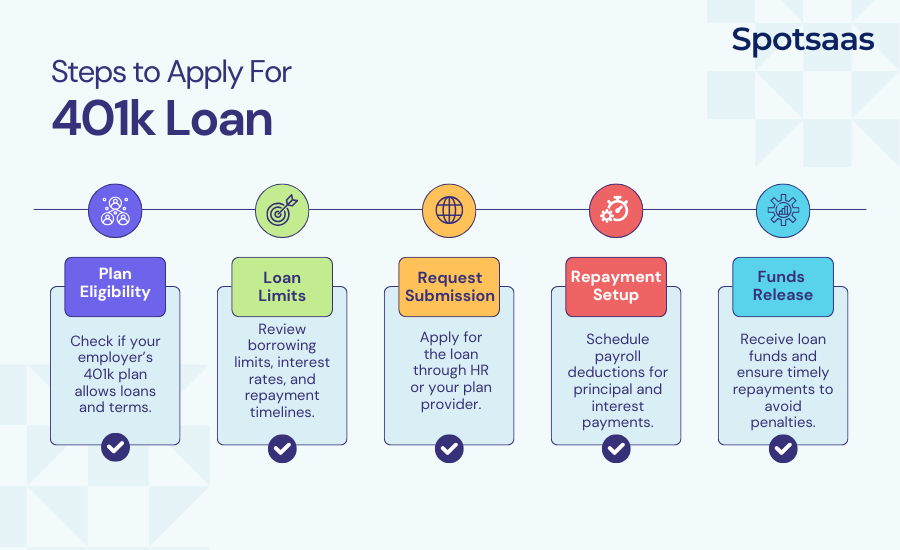
Step 1: Check If Your Employer Offers a 401(k) Loan Option
Not all employers permit 401k loans as part of their retirement plans. Review your plan documents or consult with your HR department to confirm if loans are allowed.
If permitted, check specific terms related to borrowing limits, repayment schedules, and eligibility requirements.
Step 2: Understand 401(k) Loan Limits, Interest Rates, and Terms
Most plans allow employees to borrow up to 50% of their vested balance, with a maximum cap of $50,000. Interest rates are generally prime rate + 1%, and repayment is typically required within five years, except for home purchases.
Understanding these details helps in planning for timely repayment and avoiding penalties.
Step 3: How to Submit a 401(k) Loan Application
Once you have reviewed the plan details, submit a formal loan request through your plan provider’s website or HR department. Some providers may require completing an online application, while others might ask for a paper form.
Be ready to provide details such as loan amount, purpose, and repayment preference.
Step 4: Set Your 401(k) Loan Repayment Schedule
After approval, set up your repayment plan, which is usually deducted directly from your payroll. Payments include both principal and interest, ensuring that the amount is repaid into your 401k account over time.
If your plan allows flexibility, you may choose a shorter repayment period to minimize the impact on long-term savings.
Step 5: Disbursement and Staying on Track with 401(k) Loan Repayments
Once approved, funds are disbursed via direct deposit or check, depending on your plan’s policies. Start making repayments as scheduled to avoid defaulting.
If you leave your employer before fully repaying the loan, you may need to repay the remaining balance in full within a specific timeframe to prevent it from being treated as a taxable distribution.
Following these steps ensures that borrowing from your 401k remains a well-managed decision without affecting long-term retirement goals.
Check More – How to Choose the Best 401k Provider for Your Business
How 401(k) Loans Affect Your Retirement Savings and Financial Future
Whilst some would consider that a 401k loan gives immediate access to funds, such loans will have far-reaching effects on the personal retirement savings.
Borrowing from a retirement account is essentially a temporary decrease in the funds available for investment, which may negatively affect financial security later on in life.
Impact of Missed Compound Growth Due to 401(k) Loans
A major plus point with a 401k is the benefit of savings growth through compounding. Cashing out funds for a loan stops investments growing with the market.
The return paid back towards the loan is definitely not equivalent to the market gains missed over several years, which can greatly reduce the total retirement balance.
Will a 401(k) Loan Affect Employer Matching Contributions?
Certain employers withdraw 401k matching contributions from employees until such time as loans are repaid. Thus, employees in the process of repaying a loan may be deprived of free contributions from employers, thus reducing the overall retirement savings.
Even if the employer persists in providing matching, repayments taken out by the employee may limit that employee’s ability to add anything towards a match, hampering growth overall.
How Borrowing Impacts Long-Term Retirement Security
Since a 401k loan takes away the money to be invested in the account, it may, in turn, mean working for longer or saving more to make up for the deficit in savings for retirement.
Failure to repay a loan on time could turn it into a taxable distribution. Consequently, this loan can bring about penalty taxes and added tax liabilities, thus causing the loss of the ability to maintain a standard of living after retirement.
One must weigh the things above carefully before making any financial decisions that would need short-term borrowing, as it may be at a greater risk to short-term retirement viability.
Tax Rules and Penalties on 401(k) Loans Explained
While it can provide access to cash without an immediate tax impact under a 401k loan, there are certain tax considerations behind this. So, before borrowing from a retirement account, it is important to understand how these issues will affect repayments and withdrawals.
Why 401(k) Loan Interest Creates Double Taxation
401k loan repayments, including the interest, are made with after-tax dollars. Thus, while traditional 401k contributions are made using pre-tax dollars, in this case, the amount will be taxed again when taken out in retirement. This results in a situation of double taxation on the interest portion of the loan.
What Happens if You Default on a 401(k) Loan?
If a borrower quits a job or defaults on the loan, the outstanding loan balance will be treated as a taxable distribution. It means all remaining amounts will be taxed (federal and state), which is going to decrease the total retirement savings that may be available in the future.
Early Withdrawal Penalties for 401(k) Loans Before Age 59½
If a loan balance is not repaid and is determined to be a taxable distribution, borrowers who are younger than age 59½ may be subject to a 10% early withdrawal penalty in addition to income taxes. This will further compound the cost of borrowing and impact overall financial planning.
To avoid finding themselves in a situation of an unforeseen tax burden, it is important to have a repayment plan in mind and to consider borrowing from all avenues before applying for a 401k loan.
Should Employers Offer 401(k) Loans? Key Considerations in 2025
Employers who offer 401k loans as part of their retirement plans must carefully weigh the benefits and risks. While providing access to retirement funds can help employees manage financial challenges, it also comes with administrative responsibilities and potential drawbacks for businesses.
| Consideration | Description |
|---|---|
| Benefits of Allowing Access to Funds | Provides financial relief during emergencies and enhances employee retention and satisfaction. |
| Automatic Payroll Deductions | Ensures structured loan repayment, reducing financial stress for employees. |
| Administrative Costs for Employers | Employers must manage loan processing, compliance tracking, and IRS reporting. |
| Handling Employee Departures | If employees leave before full repayment, employers must manage taxable distribution reporting. |
| Educating Employees on Borrowing | Offering financial literacy programs helps employees understand borrowing impacts and alternatives. |
| Encouraging Alternative Financial Solutions | Guiding employees to explore other borrowing options before taking a 401k loan ensures better financial decisions. |
Pros and Cons of Taking a 401(k) Loan in 2025
Taking a 401k loan can be an attractive option for those who need quick access to funds, but it also comes with potential downsides. Here’s a breakdown of the advantages and disadvantages:
| Pros | Cons |
|---|---|
| No credit check or lender approval required. | Missed investment growth during the loan period. |
| Interest paid goes back into the borrower’s account. | Risk of taxation and penalties if repayment is not completed. |
| Lower interest rates compared to personal loans or credit cards. | Immediate repayment required if employment ends. |
| Repayment is automated through payroll deductions. | Double taxation on loan interest (paid with after-tax dollars and taxed again at withdrawal). |
Final Thoughts: Is a 401(k) Loan Right for You?
A 401k loan can serve as a lifeline to those in urgent need of extra cash, with convenience, lower rates, and no credit scores. However, there may be some accommodation costs, such as lost investment growth, tax implications, and a higher probability of default if one becomes unemployed.
Thus, before booing from retirement savings, it is essential to weigh the options, scrutinize the repayment terms, and comprehend the long-term impact on financial security. Other options for borrowing funds can be explored to guard retirement funds yet meet immediate cash needs.
Making informed choices helps achieve some balance between short-term relief and long-term stability.
401(k) Loan FAQs: Rules, Repayment, and Risks
Can I take a 401k loan if I have bad credit?
Yes, a 401k loan does not require a credit check since you are borrowing from your own retirement savings.
How long do I have to repay a 401k loan?
Most 401k loans must be repaid within five years, but if the loan is for a home purchase, a longer repayment period may be allowed.
What happens if I leave my job before repaying my 401k loan?
The remaining balance may need to be repaid within 60 to 90 days, or it could be treated as a taxable distribution with possible penalties.
Are there penalties for not repaying a 401k loan?
If the loan is not repaid on time, it may be subject to income tax and a 10% early withdrawal penalty if the borrower is under 59½.
Can I continue contributing to my 401k while repaying the loan?
Yes, but some plans may limit contributions while a loan is outstanding, potentially affecting long-term retirement savings.
