
A well-structured comparison checklist matters once you start expanding your team across borders. Payroll, local taxes, and labor-law compliance for international employees take more than good intentions to get right; they take the right support behind you.
Rippling also offers global payroll and employer-of-record hiring as part of its unified HR platform. Try Rippling free →
That’s where Employer of Record (EOR) software comes in.
EOR software lets businesses legally hire and manage talent in countries where they have no legal entity of their own. The platforms handle onboarding, payroll, benefits, and compliance, so teams can scale into new markets without getting stuck in operational delays.
This guide is written for HR professionals, global hiring leads, startup founders, and compliance teams evaluating EOR options.
To help with that evaluation, we’ve built a practical comparison checklist covering everything from compliance and payroll to employee support and pricing.
What This EOR Software Checklist Covers (and Why It Matters)
This checklist is built to help you evaluate and choose the right EOR software for your global hiring needs with confidence.
Here’s what you’ll find in this guide:
- Which types of businesses get the most value from EOR software, with real-world scenarios.
- A structured breakdown of the categories worth comparing: compliance, payroll, tech, support, and more.
- How leading EOR platforms like Deel, Rippling, and Remote stack up on key features.
- The pitfalls of managing global hiring without legal infrastructure or support.
- A table comparing the pros and cons of managing employment independently versus using EOR software.
- A week-by-week onboarding checklist showing what happens after you pick a provider.
- Factors to weigh beyond pricing, such as employee experience, compliance coverage, and scalability.
- Quick answers to common questions about EORs, including legal compliance, speed to hire, and benefits handling.
Who Should Use EOR Software (And Why It’s Essential for Global Hiring)
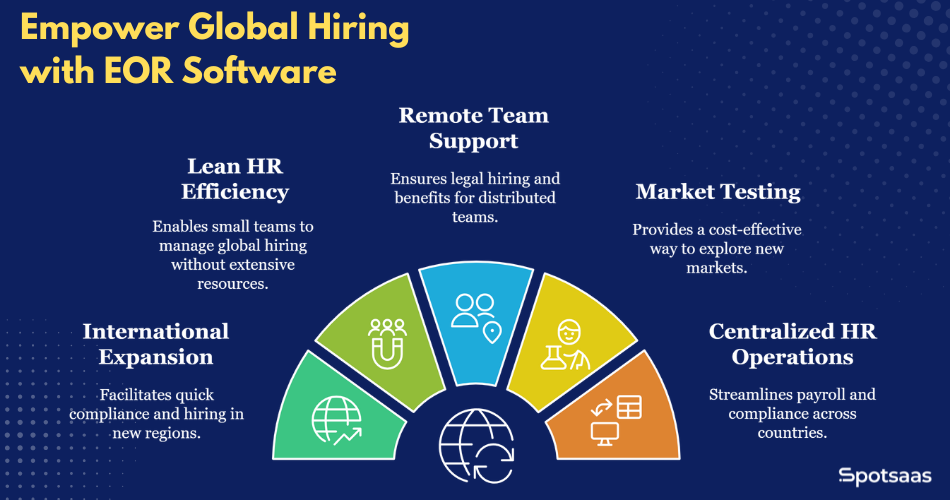
EOR software is built for companies expanding internationally who want to skip the delays, costs, and complexity of setting up local legal entities. It gives you a compliant, scalable way to onboard and manage global employees, which suits businesses that care about speed, flexibility, and control.
EOR Use Case: Companies Hiring in New Countries
If your company is entering a new region for the first time, you’ll need to comply with local labor laws, tax systems, and employment regulations. Setting up a local entity can take several months, which often isn’t worth it for small teams or an early test of a new market.
EOR providers act as the legal employer instead, so you can hire local talent in days, not months while the provider manages the legal and administrative responsibilities behind the scenes.
EOR Use Cases: Startups with Small or Lean HR Teams
Start-ups often run with limited internal resources, especially in HR and legal. Hiring internationally raises the stakes: a mistake in an employment contract or a tax filing can have real consequences.
An EOR software platform lets a small team manage global hiring without needing in-house legal or compliance expertise, so they can stay focused on product, customers, and growth.
EOR Use Case: Remote-First and Distributed Teams
Remote work has made global hiring more accessible, but it brings its own challenges. Employment law differs from one country to the next, and keeping compensation fair, benefits local, and taxes correct gets harder as the team spreads out.
EOR software closes that gap: it lets remote-first companies hire anywhere legally, offer competitive local benefits, and build trust with team members scattered across countries.
EOR Use Case: Businesses Exploring New Markets
Some companies only need a small team for a pilot program, a client project, or a short-term contract in a new country. Setting up a full legal entity for that can be overkill.
EOR software gives you a lower-risk, cost-effective way to test a new market, hire local talent quickly, and stay compliant for the life of the project.
EOR Use Case: Teams Centralizing Global HR Operations
Juggling separate vendors for payroll, compliance, benefits, and contracts across different countries tends to create fragmented workflows and communication gaps.
EOR software centralizes all of that in one platform, giving HR teams better visibility, control, and consistency across their global employees.
EOR Software: Comparison Checklist: Key Evaluation Categories
To help you evaluate EOR software with confidence, this section breaks down the core comparison points.
- Global Coverage & Compliance
- Employee Experience
- Payroll & Tax Management
- Technology & Integration
- Pricing & Contract Transparency
- Customer Support & SLAs
- Data Security & Compliance Standards
| Category | Description | Questions to Ask |
|---|---|---|
| Global Coverage & Compliance | Support for your target countries with legal and tax alignment. |
|
| Employee Experience | Smooth onboarding, local benefits, and multilingual support. |
|
| Payroll & Tax Management | Accurate multi-country payroll with automated tax handling. |
|
| Technology & Integration | Easy-to-use dashboard and integration with HR tools. |
|
| Pricing & Contract Transparency | Clear pricing, flexible terms, and detailed invoicing. |
|
| Customer Support & SLAs | Reliable support with defined SLAs and local availability. |
|
| Data Security & Compliance | Certified systems for secure data handling and privacy. |
|
EOR Compliance & Country Coverage Capabilities
How well an EOR platform covers the countries where you plan to hire is one of the most important things to check. Each region has its own employment laws, tax systems, and regulatory framework, and that requires real local expertise to manage well.
A reliable EOR provider should:
- Have active legal entities or partners in your target countries
- Stay current on regional labor laws and policy changes
- Handle employment contracts, benefits, taxes, and terminations according to local regulations
- Protect IP and reduce risk in international employment
Also check how often the provider expands into new regions, and whether their legal infrastructure is owned outright or run through partners. That distinction affects how much control, service speed, and accountability you actually get.
Questions to ask:
- Which countries do you actively support?
- Do you operate through your own entities or third parties?
- How do you stay updated on regulatory changes in each country?
Evaluating EOR Software by Employee Experience
Compliance and EOR payroll matter, but the experience your international employees have with the provider can make or break how long they stay. Smooth onboarding, clear communication, and access to local benefits build trust with a global team fast.
Look for EOR software that:
- Runs onboarding on a clear timeline with straightforward document collection
- Provides locally competitive benefits such as healthcare, pension plans, and paid leave
- Delivers timely payslips in the employee’s local language and currency
- Has support channels in the employee’s time zone and language
- Offers a self-service portal for pay history, benefits, and documents
The goal is making sure employees feel supported even when they’re working far from your headquarters.
Questions to ask:
- How long does onboarding typically take in [target country]?
- What local benefits are included in your employment package?
- How do employees access their payroll and HR information?
How EOR Software Handles Global Payroll and Tax Compliance
Accurate, on-time payroll isn’t optional. Confirm the EOR platform can handle complex, multi-country payroll and tax compliance without trouble.
What to look for:
- Multi-currency payroll processing
- Automatic tax calculations and filings
- Payslips that are clear and easy to read
- Smooth handling of reimbursements, bonuses, and other add-ons
Questions to ask:
- How do you manage payroll differences between countries?
- What systems are in place for local tax compliance?
- Can you support bonus structures or expense reimbursements?
EOR Software Integrations and Platform Usability
A easy-to-use platform with solid automation saves your HR and finance teams real time. The best EOR providers keep their interfaces simple and offer real integration options.
What to look for:
- Central dashboard for HR, payroll, and compliance tracking
- Self-service access for both employers and employees
- Integrations with tools like HRIS, ATS, accounting platforms
- Real-time reporting and data exports
Questions to ask:
- Is the platform self-serve or service-led?
- What integrations do you support?
- Can we generate custom reports?
Understanding EOR Pricing Models and Contract Terms
EOR pricing models vary quite a bit: some charge per employee, others use country-specific rates or bundled services. It’s worth understanding exactly what’s included before you sign anything.
What to look for:
- Clear, upfront pricing with no hidden fees
- A cost breakdown covering salary, employer taxes, and admin fees
- Flexible contract terms without long lock-ins
- Transparent invoicing and billing frequency
Questions to ask:
- What’s your pricing model, and what does it include?
- Are there any setup, offboarding, or exit fees?
- Can you share a sample invoice?
Evaluating EOR Support Quality and SLAs
Hiring globally means working across time zones. Make sure the EOR provider backs that up with consistent support and defined service standards.
What to look for:
- Dedicated account manager or support team
- Local support teams available during business hours
- Clear service level agreements (SLAs) for onboarding, payroll, and issue resolution
- Multi-channel support (email, phone, chat)
Questions to ask:
- Who will be our main point of contact?
- What are your response and resolution timeframes?
- Do you offer regional support teams?
EOR Data Protection, Security Certifications, and Compliance
When you’re handling employee data and payroll records across multiple countries, data security stops being optional. It becomes a core requirement.
What to look for:
- Compliance with GDPR, SOC 2, ISO 27001, or local equivalents
- Secure document storage and encryption
- Role-based access control for employers and employees
- Regular audits and third-party security assessments
Questions to ask:
- What certifications do you hold for data protection?
- Where is employee data stored?
- How do you handle data access and security breaches?
Global Compliance Checklist: EOR Country Support Questions
| Feature Category | Deel | Rippling | Remote |
|---|---|---|---|
| Global Coverage | 100+ countries supported | 50+ countries (via partners) | 70+ countries with owned entities |
| Onboarding Time | 2–5 business days | Varies by country | 2–6 business days |
| Payroll & Taxes | Multi-currency, automated | Integrated with payroll stack | Localized tax compliance |
| Employee Benefits | Localized benefits options | US-focused, add-ons for global | Country-specific packages |
| Tech & Integrations | Standalone platform | Deep integration with HRIS & IT | Dashboard + API access |
| Pricing Transparency | Per employee per month | Varies by country + platform fee | Transparent pricing by country |
| Support & SLAs | 24/7 global support | Regional account managers | Dedicated support team |
| Compliance & Security | GDPR, SOC 2, ISO certified | SOC 2 compliant | GDPR, SOC 2, ISO certified |
Pricing shown is approximate; check vendor websites for current rates.
What Happens If You Don’t Use EOR Software?
Hiring in another country without a proper legal structure can expose your business to real risk. Plenty of companies try to manage contracts, payroll, and benefits informally, or lean on freelancers instead, and that approach tends to create problems down the line.
Here are the main compliance risks businesses run into when they skip EOR software:
Worker Misclassification
Treating a full-time employee as a contractor, whether on purpose or by accident, can trigger penalties, back payments, and legal action in many countries. Local authorities may read the arrangement as tax avoidance or a labor law violation.
Tax and Payroll Errors
Every country has its own tax structure, social contributions, and payroll rules. Without local expertise, it’s easy to miscalculate withholdings or miss a mandatory filing, which can lead to audits, fines, or frozen accounts.
Breach of Employment Laws
Statutory benefits, termination rules, and everything in between vary widely from one country to the next. Missing these requirements, even by accident, can damage your reputation and open you up to legal claims.
IP and Ownership Risks
Without employment contracts governed by local law, your intellectual property (IP) may not be fully protected. That risk matters even more for product-based and tech companies.
Delayed Market Entry
Working through entity setup, legal processes, and compliance hurdles on your own can take months, which slows down your hiring plans and project timelines.
EOR vs DIY Global Hiring: Pros, Cons, and Comparison Table
Here’s a side-by-side look at the trade-offs:
| Factor | EOR Model | DIY Setup (No EOR) |
|---|---|---|
| Speed to Hire | 1–2 weeks | 3–6 months (avg. for legal entity setup) |
| Compliance Support | Built-in local legal expertise | Requires hiring legal consultants |
| Tax Management | Handled by EOR platform | Fully manual and varies by country |
| HR Admin | Centralized platform | Handled by internal team or vendors |
| Employee Benefits | Offered through local packages | Must be sourced and managed independently |
| Cost | Fixed monthly fee per employee | High setup and ongoing legal costs |
| Scalability | Easy to add/remove countries as needed | Entity must be established in each location |
Pricing shown is approximate; check vendor websites for current rates.
The Verdict: Managing compliance on your own can look flexible at first glance, but the risk usually outweighs whatever you’d save. EOR providers bring structure, speed, and peace of mind so you can spend your time building the team instead of the legal infrastructure underneath it.
EOR Implementation Timeline and Onboarding Checklist (Week-by-Week)
Choosing the right EOR provider is a big step, but what comes after matters too. A well-defined onboarding process keeps the transition smooth for your team and avoids needless delay.
Here’s a typical 4-step onboarding timeline most companies follow once they’ve signed with an EOR partner:
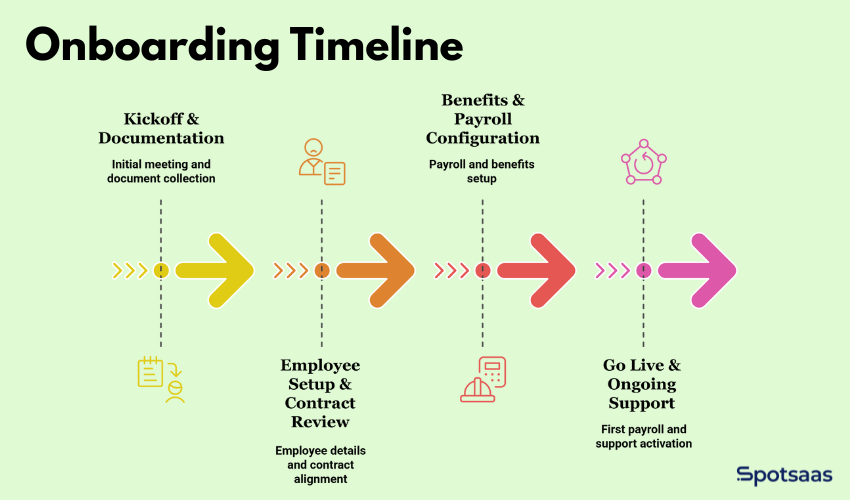
Week 1: Kickoff & Documentation
- Intro call with your dedicated account manager or onboarding specialist
- Define hiring countries, employee types, and timelines
- Share initial company details and business objectives
- Submit required documents (company registration, identification, etc.)
Goal: Set expectations, confirm scope, and start collecting documentation.
Week 2: Employee Setup & Contract Review
- Provide employee details: role, salary, location, start date
- EOR drafts locally compliant employment agreements
- Legal team reviews contracts
- Employees receive and sign offer letters or employment agreements
Goal: Align contracts with local laws and your company’s policies.
Week 3: Benefits & Payroll Configuration
- Finalize payroll schedule (monthly/biweekly), pay dates, and currency
- Configure tax deductions, benefits, and bonuses (if applicable)
- Add employees to the EOR’s HR/payroll platform
- Confirm benefits eligibility and enrollment based on country
Goal: Get payroll and benefits set up accurately and compliantly.
Week 4: Go Live & Ongoing Support
- First payroll run initiated
- Employees get access to HR portals for payslips and documents
- Managers receive reporting dashboards (if included)
- Ongoing support channels activated for HR or legal queries
Goal: Make sure everything runs smoothly and employees are fully onboarded.
Final EOR Buying Tips Before You Choose a Provider
Picking an EOR platform isn’t just a box-checking exercise; it’s a decision that shapes your global hiring foundation. Before committing, weigh the bigger picture: compliance, employee satisfaction, and long-term scalability.
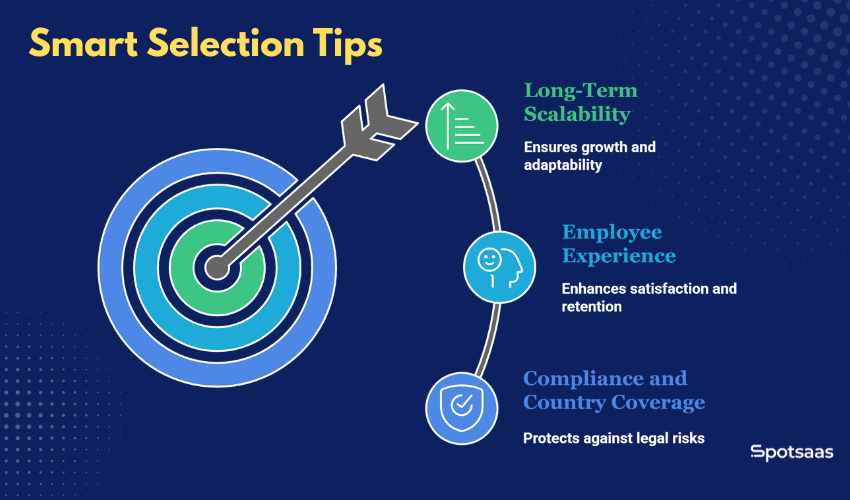
Here’s a closer look at three factors worth prioritizing in your final decision:
Prioritize Compliance and Country Coverage
Pricing tends to grab attention first, but the compliance layer is what actually protects your business from risk. Every country has its own employment laws, tax obligations, benefits requirements, and reporting deadlines. A provider with deep, in-country legal entities keeps your operations legally sound and ready for an audit.
Ask yourself:
- Does this provider support all the countries I plan to hire in?
- How often do they update their contracts as labor laws change?
- Can they handle both full-time employees and contractors compliantly?
A provider with reliable global coverage lets you move faster and with more confidence, without worrying about red tape or a legal misstep.
Consider the Employee Experience
EOR software doesn’t just affect your HR team; it shapes how your international employees experience your brand day to day. Slow onboarding, weak benefits, or late payroll all lead to frustration and early turnover.
A platform built around clear communication, timely payments, and region-specific benefits makes for a smoother employee journey. Look for providers that offer:
- Localized onboarding flows
- Support in the employee’s native language
- Transparent payslip breakdowns and benefits explanations
The better that experience is for your team, the more trust you build, especially with new or remote teams.
Look for Long-Term Scalability
Your hiring needs today might cover just one or two countries, but that can change fast. Whether you’re moving into new markets, adding contractors alongside full-time staff, or rethinking your benefits strategy, your EOR partner needs to scale with you without adding friction.
What to look for:
- A global roadmap that matches your expansion plans
- Flexible contract terms that support growth or downsizing
- Easy onboarding for future hires across different roles or locations
Scalability isn’t just about handling a bigger headcount; it’s about keeping the same service and compliance standard as your workforce grows.
Working through these three areas before you sign means you’re not just choosing an EOR for right now, but one that can grow with your team and support where your global hiring is headed.
Final Thoughts: Choosing the Right EOR Software for Global Expansion
Choosing the right EOR software is a strategic call that touches every part of your global hiring, from compliance and payroll to employee satisfaction and growth potential. A clear comparison checklist, focused on the factors that actually matter, helps you avoid costly mistakes and sets your international team up for long-term success.
Whether you’re hiring in one country or ten, the right EOR partner gives you the confidence to scale without adding complexity. Take the time to evaluate thoroughly and pick a solution that fits your goals, timeline, and vision for global expansion.
EOR Software FAQs: Common Questions About Global Hiring
How fast can I hire through an EOR?
Most EOR providers can onboard employees within 1 to 2 weeks.
Can I offer local benefits through an EOR?
Yes, EORs typically provide country-specific benefits like healthcare and paid leave.
Is using an EOR legally compliant?
Yes, as long as the EOR has legal infrastructure in place and operates according to local labor laws.
