
EOR software is built to simplify international employment. It allows companies to legally hire, pay, and manage employees in other countries without setting up a local entity. Instead of navigating country-specific labor laws or managing global payroll manually, businesses can rely on a single platform that handles it all—securely and efficiently.
Rippling also offers global payroll and employer-of-record hiring as part of its unified HR platform. Try Rippling free →
For decision-makers exploring ways to scale teams across borders, understanding how EOR software works—and what it can do—is an essential first step. This guide breaks it down clearly, helping you evaluate whether it’s the right fit for your global hiring strategy.
What You’ll Learn About Employer of Record (EOR) Software
For companies exploring global hiring solutions, this guide offers a clear overview of how Employer of Record (EOR) software works—and how to choose the right platform for your business.
Here’s what you’ll find inside:
- A breakdown of what EOR software is and how it supports international hiring
- Key features to look for when evaluating providers
- Benefits of using EOR platforms to manage global teams
- Common use cases and challenges to watch for
- Practical steps to choose, implement, and scale with EOR software
- Latest trends shaping the EOR market in 2026
Whether you’re expanding into new regions or streamlining your current global operations, this guide will help you make informed decisions and move forward with confidence.
What is Employer of Record (EOR) Software and How Does It Work?
An Employer of Record (EOR) is a third-party service that becomes the legal employer of your international workforce—allowing businesses to hire globally without setting up local entities or navigating complex labor laws in each country. The company you work for still directs the employee’s day-to-day work; the EOR handles the legal and administrative side of the employment relationship.
EOR software enhances this model by providing a centralized platform to manage global employment tasks like onboarding, payroll, benefits, tax compliance, and employee documentation—all in one place. This helps companies stay compliant while focusing on growth, not administrative overhead.
When comparing EOR vs PEO, the distinction lies in scope and structure. A PEO typically co-employs staff and is limited to countries where the business already has an entity. In contrast, an EOR takes full legal responsibility and allows companies to hire in new countries without any local setup.
Core functions typically include:
- Global onboarding: Quickly set up new hires with compliant employment contracts and documentation
- Payroll management: Run payroll across multiple countries with local currency support and tax handling
- Tax and compliance support: Stay aligned with local labor laws, social contributions, and reporting
- Benefits administration: Provide region-appropriate benefits without navigating local policies yourself
- Contract generation and HR support: Access localized templates and expert guidance
In short, EOR software allows companies to scale international teams without legal risk, all through a single, easy-to-manage platform. That combination of speed and reduced legal exposure is usually the main reason a company chooses this route over setting up its own foreign entity.
Who Uses EOR Software and Why It’s Valuable for Global Hiring
EOR software is used by a wide range of businesses that want to hire talent across borders—without the legal complexity or high cost of setting up entities in each country. Whether it’s a fast-growing startup or a large enterprise, these platforms offer a practical way to manage international hiring while staying compliant.
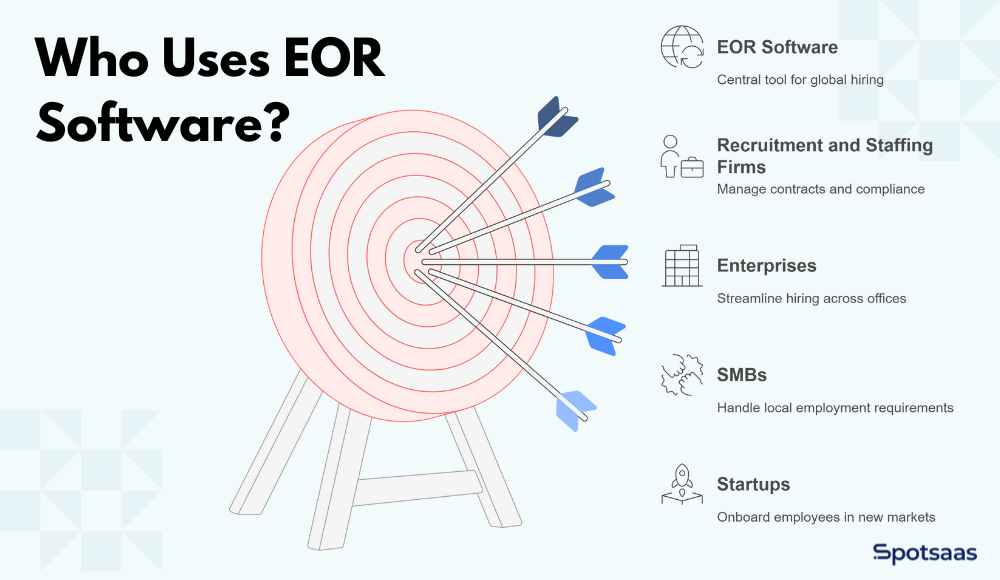
Startups expanding globally
Early-stage companies often want to tap into international talent pools but may not have the resources to establish legal entities in every location. EOR software helps them onboard full-time employees legally in new markets—allowing them to scale quickly and stay compliant from day one.
Small and midsize businesses (SMBs)
SMBs looking to grow remote teams across multiple countries use EOR software to handle local employment requirements, payroll, and tax filings. It removes the need for legal teams in every country and allows SMBs to compete globally with a lean setup.
Enterprises managing distributed workforces
Larger organizations use EOR platforms to simplify hiring and compliance across global offices and remote hubs. For HR and finance teams, the software centralizes employment processes and ensures uniformity across countries, reducing administrative overhead and legal risk.
Recruitment and staffing firms
Firms that place international workers for their clients rely on EOR software to manage employment contracts, benefits, and compliance in multiple jurisdictions. This allows them to offer complete global hiring solutions without managing local HR infrastructure themselves.
Whether the goal is to test a new market, hire remote specialists, or scale operations across borders, EOR software is a smart choice for organizations that want to grow globally while keeping hiring fast, legal, and low-risk.
Top Features of Employer of Record (EOR) Software for Global Teams
When evaluating EOR platforms, it’s important to focus on the features that simplify global hiring while reducing legal and operational stress. Below are five essential features every buyer should look for—each designed to support dependable international employment operations.
Global Payroll Automation & Compliance Support
Handling payroll across multiple countries can be complex—each location comes with its own rules, currencies, and deadlines. EOR software takes care of it all by automating salary calculations, tax deductions, and payments in local currency.
It also provides audit trails and payslip generation to meet local requirements. With centralized EOR payroll management, finance teams get full visibility and control without having to juggle multiple vendors.
Compliance Automation and Contract Management in EOR Platforms
From labor laws to data regulations, staying compliant in every country is a moving target. EOR platforms help businesses stay aligned by automatically generating localized contracts, managing employment documentation, and updating policies in line with legal changes.
This reduces the risk of manual errors and helps companies avoid unexpected penalties. Legal updates are handled in the background, so HR and legal teams don’t have to chase regulatory changes.
Localized Benefits Administration Through EOR Platforms
Offering region-specific benefits is key to attracting and retaining top talent. EOR software allows companies to provide healthcare, retirement plans, and other perks that meet local standards—without needing in-house experts in every country.
Platforms often negotiate better local plans due to economies of scale. Employees also get a consistent experience through self-serve portals to access their benefit details and resources.
Employee Onboarding Workflows in Global EOR Software
A smooth onboarding process sets the tone for employee success. With EOR software, you can handle contract signing, collect documents, and assign tasks—all in one place.
Onboarding workflows can often be customized by country or role. This ensures every new hire receives the right information and setup experience, even across different regions.
Country Specific Leave and PTO Management via EOR
Managing leave policies across countries with different holidays, sick leave rules, and paid time-off standards can get complicated. EOR platforms offer built-in tools to track time-off requests, ensure policy alignment, and maintain records that comply with local labor laws.
Managers and employees can access real-time leave balances and approvals through dashboards. It simplifies workforce planning and improves transparency across the organization.
5 Key Benefits of Using EOR Software for Global Employment
EOR software makes it easier for businesses to grow across borders without getting slowed down by complex employment laws or operational bottlenecks. Here are five key benefits that highlight why more companies are turning to these platforms to manage global hiring:
| Benefit | Description |
|---|---|
| Hire Globally Without Setting Up Foreign Entities | Skip the need to establish legal entities. Onboard global talent faster and test new markets with lower risk. |
| Stay Compliant With Local Labor Laws | Platforms handle contracts, benefits, and terminations in line with local laws, reducing legal risk. |
| Reduce Administrative and Legal Workload | Centralizes HR tasks like payroll and documentation, freeing up internal resources for strategic work. |
| Speed Up Hiring and Onboarding Timelines | Provides pre-built infrastructure for faster international hiring and a consistent onboarding experience. |
| Improve Accuracy in Payments and Tax Handling | Ensures timely, compliant payroll and tax processes through automation and local expertise. |
Hire Globally Without Setting Up Foreign Entities
Setting up a legal entity in a new country can be time-consuming, expensive, and full of regulatory hurdles. EOR software removes that need by acting as the legal employer, allowing businesses to onboard talent anywhere in the world.
This helps teams enter new markets faster, test international hiring strategies, and grow without committing to a full legal presence.
Stay Compliant With Local Labor Laws
Every country has its own rules around contracts, benefits, working hours, and terminations. EOR platforms keep businesses compliant by handling these legal details in the background.
They continuously monitor local regulations, which helps your business follow the right procedures and avoid costly legal issues.
Reduce Administrative and Legal Workload
Managing HR processes, payroll, benefits, and documentation across multiple countries takes a lot of time and coordination. EOR software centralizes these tasks in one platform.
This frees up internal teams to focus on strategy and growth instead of paperwork while ensuring everything stays accurate and well-documented.
Speed Up Hiring and Onboarding Timelines
Hiring international employees can often take weeks—or months—when done manually. EOR platforms cut that timeline significantly by offering ready-to-go infrastructure and compliance tools.
New hires can start faster, and HR teams can deliver a more consistent onboarding experience across every region.
Improve Accuracy in Payments and Tax Handling
Errors in payroll or taxes can damage employee trust and lead to compliance issues. EOR software ensures that salaries, deductions, and tax filings are processed correctly in each country.
With built-in automation and local expertise, businesses reduce the risk of mistakes and ensure timely, compliant payments.
Common EOR Software Challenges and How to Address Them
While EOR software offers a more organized way to manage global hiring, there are a few challenges that businesses should be aware of during evaluation and implementation. Understanding these early can help teams make informed decisions and avoid disruptions later on.
| Challenge | Description |
|---|---|
| Understanding Local Labor Laws | Every country has its own labor laws covering employment terms, notice periods, and working hours. |
| Managing Contracts and IP Ownership | Employment agreements and IP clauses must be structured carefully to protect the business, considering local laws that impact IP rights. |
| Ensuring Data Security Across Countries | Handling employee data across regions involves different privacy standards, such as GDPR. Look for strong encryption and local hosting options. |
| Navigating Different Benefit Systems | Benefit expectations vary widely by region. The right EOR solution tailors packages that align with local standards without overspending. |
| Vendor Lock-In or Limited Country Coverage | Some platforms may not support all desired countries or enforce long-term contracts, so it’s important to evaluate future expansion plans. |
Navigating Local Labor Laws with EOR Software
Each country has its own set of labor laws covering employment terms, notice periods, working hours, and termination procedures. While EOR providers manage compliance, it’s still important for internal teams to stay informed and aligned with the overall strategy.
Having access to clear legal guidance within the platform can help teams feel more confident when hiring in unfamiliar markets.
How EOR Software Handles IP Ownership and Employment Contracts
Employment agreements and intellectual property clauses need to be carefully structured to protect the business. In some countries, local laws may impact how IP is assigned or protected through employment contracts.
Choosing the right EOR Software with legal expertise across jurisdictions can help ensure contracts meet both legal and business needs.
Data Security and Compliance in Global EOR Platforms
Handling employee data across multiple regions means dealing with different privacy standards and regulations, such as GDPR in Europe or local data residency rules.
Strong encryption, local data hosting options, and clear policies for access control are essential features to look for when evaluating a provider.
Regional Benefit Customization in EOR Software
What counts as a standard benefit—such as health insurance or paid leave—can vary greatly across regions. Offering the right mix of benefits without overspending requires local insight and the ability to tailor packages.
The best EOR software helps companies remain attractive to talent by offering country-specific benefit options that align with local expectations.
EOR Platform Limitations: Vendor Lock-In and Country Availability
Some EOR platforms may not support all the countries a business plans to hire in, or they may require long-term contracts that reduce flexibility.
Before committing, it’s important to evaluate current and future expansion plans to ensure the platform offers the geographic reach and adaptability the business needs.
EOR Software Alternatives: PEOs, Local Entities, and Contractors
While EOR software is a powerful solution for global hiring, it’s not the only option. Depending on your hiring goals, budget, and timeline, other approaches may be worth exploring.
When to Set Up a Local Entity Instead of Using an EOR
For companies planning a long-term presence in a specific country, establishing a legal entity can provide full control over hiring, operations, and compliance. This approach is more resource-intensive, often involving legal, financial, and administrative setup, and it usually only pays off once headcount in that country is large enough to justify the fixed cost.
It’s better suited for organizations with larger teams or a permanent footprint in one region.
PEOs vs. EOR: When Staffing Agencies Make More Sense
Professional Employer Organizations (PEOs) or staffing firms offer HR and EOR payroll services through co-employment models. While they can support domestic or regional hires, they typically don’t act as the legal employer in foreign countries.
This makes them a good option for short-term staffing needs or when the company already has a legal presence in the country.
Managing International Contractors Without EOR Software
If full-time employment isn’t required, hiring independent contractors can be a flexible option. Contractor management platforms help with payments, agreements, and compliance for freelance or project-based workers.
That said, it’s important to avoid misclassification and ensure local rules support contractor arrangements in your target country.
How Much Does EOR Software Cost in 2026?
Understanding the cost of EOR software is a key part of choosing the right provider. While pricing structures vary, most platforms follow a per-employee, per-month model that includes core services such as payroll, compliance, onboarding, and benefits administration.
Typical Pricing Structure
Most EOR providers charge a flat monthly fee for each employee you hire through their platform. This fee usually covers payroll processing, employment contracts, tax handling, and local compliance support.
Some platforms may also offer service-based pricing for enterprise clients or companies with specific country needs.
EOR Software Cost Range by Country and Service Complexity
Pricing typically ranges from $200 to $1,000+ per employee per month, depending on the country, the complexity of local labor laws, and the level of support required. Hiring in countries with strict employment regulations or high administrative overhead may fall on the higher end of that range.
Pricing shown is approximate; check vendor websites for current rates.
Add-On Services in EOR Software: What to Expect
In addition to the base fee, some EOR platforms offer optional services such as:
- Intellectual property protection
- Customized legal agreements
- In-country HR consulting
- Enhanced benefits packages
- Immigration or visa support
These services may come at an additional cost, so it’s important to clarify what’s included in the standard package and what counts as an add-on during the vendor evaluation process.
By using a detailed comparison checklist to evaluate pricing models and bundled features, businesses can better estimate total costs and ensure the platform aligns with their budget and hiring plans.
How to Implement Employer of Record (EOR) Software Successfully
Getting started with EOR software is typically a smooth process—especially when the provider offers strong onboarding support and clear documentation. While the setup timeline can vary based on the countries involved, most businesses can expect to be up and running within a few weeks.
EOR Setup Timeline: How Long Implementation Takes
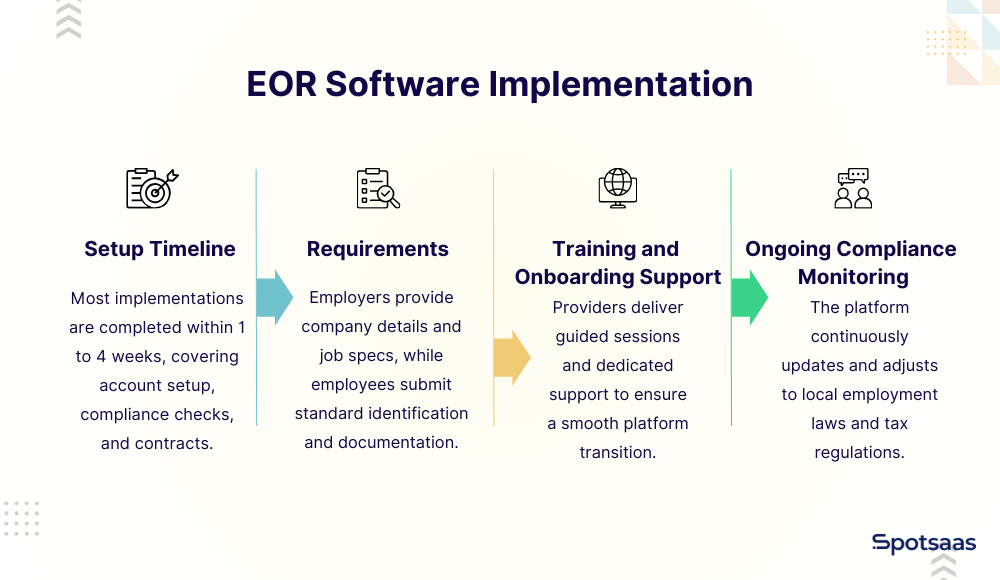
On average, the implementation process takes 1 to 4 weeks. This includes account setup, compliance checks, contract preparation, and coordination with local teams. Some platforms offer faster onboarding in select countries where infrastructure is already in place.
Employers and Employee Requirements for EOR Software Setup
To begin the process, employers are usually asked to submit company details, points of contact, and intended roles or job descriptions for each hire.
Employees will need to provide standard documents such as identification, proof of address, banking information, and tax forms as required by local law.
EOR Software Onboarding: Training and Support Options
Most EOR providers offer guided onboarding sessions for HR and finance teams, along with resources to help employers and employees get familiar with the platform. Some also assign dedicated account managers to walk through the setup and handle any country-specific questions.
This ensures a smooth handoff and reduces the chances of delays or confusion during the early stages.
Continuous Compliance Monitoring with EOR Platforms
Once employees are onboarded, the platform continues to monitor local employment laws, tax regulations, and benefit requirements. If any legal updates occur, the system automatically adjusts to keep your company aligned with current standards.
This ongoing support is a major reason why businesses rely on EOR solutions to manage compliance long after the initial setup is complete. Labor rules change more often than most HR teams can track on their own, especially across a dozen or more countries at once.
Final Thoughts: Choosing the Right EOR Software for Global Hiring
EOR software has become a vital tool for companies looking to hire and manage talent across borders—without getting caught up in the complexities of international compliance. Whether you’re expanding into new markets or building a fully remote team, these platforms offer a more direct path to employ talent worldwide legally.
For fast-scaling businesses, EOR solutions help reduce overhead, speed up hiring timelines, and remove the barriers that often slow global growth. Everything is handled through one platform, from onboarding and payroll to tax handling and local benefits, so your team can focus on performance, not paperwork.
Employer of Record (EOR) Software FAQs
What does an Employer of Record (EOR) do?
An EOR legally employs workers on your behalf in foreign countries, handling payroll, contracts, and compliance.
How is EOR different from a PEO?
An EOR becomes the legal employer, while a PEO shares responsibilities with a company that already has a legal entity.
Is EOR software suitable for small businesses?
Yes, EOR software is ideal for startups and SMBs looking to hire globally without setting up foreign entities.
